
Which air dryer do I need?
Dew point in plain words, and the one temperature that decides the type.
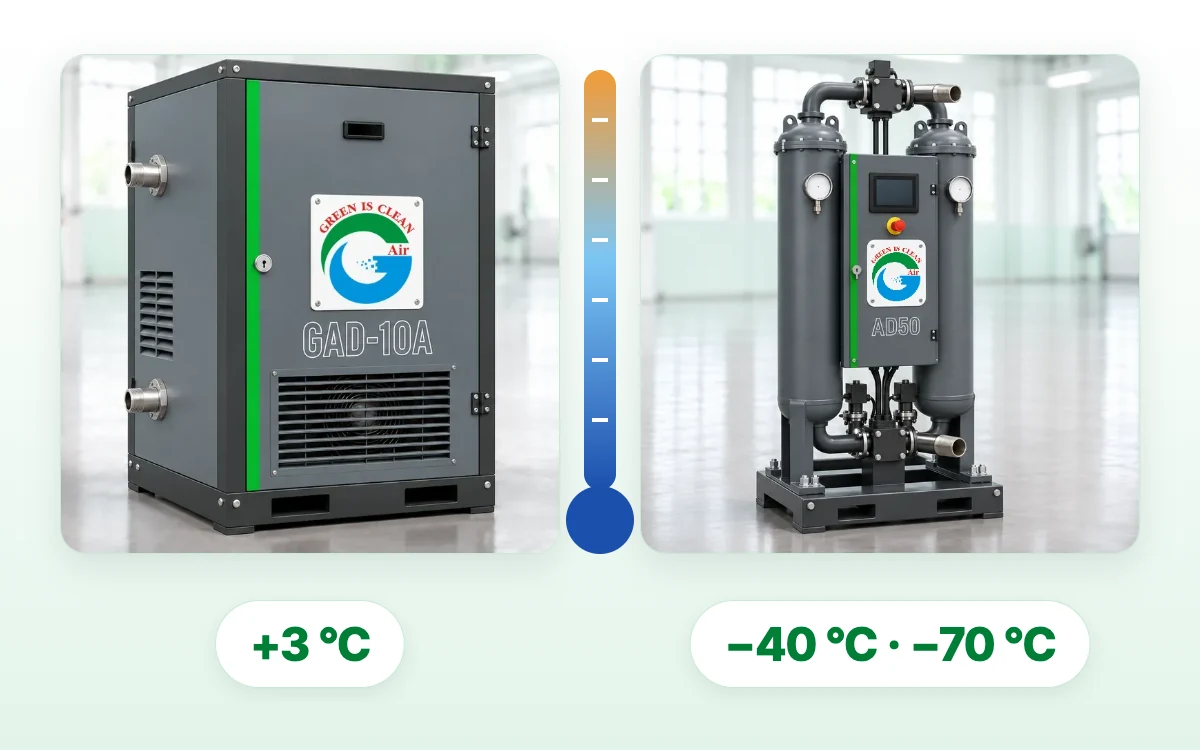
One temperature decides it
All air holds water, and warm air holds far more of it. At 35 °C and 70% humidity every cubic metre carries about 28 grams. Once it has been compressed and cooled that air can keep only a fraction of it, and the rest becomes liquid, in the receiver if you are lucky and in your pipework if you are not.
A dryer is chosen by one number, the pressure dew point. It is the temperature at which the water that is left would begin to condense at your working pressure. If no part of the pipe ever gets colder than that, no water appears.
So find the coldest place the pipe passes, on the coldest night of the year. That temperature decides the dryer, and the rest is arithmetic.
What each type gives you
Refrigerant
Cools the air so that the water drops out, then warms it again. Reaches about +3 °C, takes 1 to 2% of the compressor's power, and is right for almost everything indoors.
Heatless desiccant
Two towers of drying beads that take turns. Reaches −40 °C, or −70 °C where it is asked for. Between 12 and 18% of the dry air goes to clean the resting tower, and that is its running cost.
Heated desiccant
The same two towers, cleaned with heat or a blower and 2 to 3% of the air or none at all. Dearer to buy, and the better answer on large flows.
Membrane
A bundle of hollow fibres, with no moving parts and no power. For a single machine, a cabinet or a remote panel.
Read the rating
A dryer rated at 25 °C loses about a third of its capacity at 45 °C. One chosen from a European table is too small for a Gulf summer.
Two dryers in one plant
A refrigerant dryer on the main and a small desiccant dryer on the one line that goes outside is often the cheapest arrangement of all.
How to choose, in three steps
Find the coldest point the air will reach: an outside wall, a cold store, a night in January. Take a dew point about 10 °C below it.
Take the flow the compressor really delivers, the lowest pressure you run and the hottest air that will go in. Correct the dryer's rating for all three, because they are never the ones on its label.
Look at what stands before it. A dryer fed straight from a hot compressor, without an aftercooler and a separator, is doing two jobs and will fail at both.
- Coldest point of the pipe found first
- Dew point about 10 °C below it
- Delivered flow, not the nameplate
- Lowest pressure and hottest inlet used
- Correction factors applied
- Aftercooler and separator before the dryer
- Oil filter before a desiccant dryer
- Dust filter after a desiccant dryer
How much water is it?
Take a compressor delivering 5 m³/min, which is about 30 kW, drawing in air at 35 °C and 70% humidity. It takes in 28 grams of water with each cubic metre, which is 8.3 litres an hour.
After the aftercooler, at 7 bar and 40 °C, the air can hold only 6.5 grams of that. About 6.4 litres an hour falls out before the dryer, and the dryer takes out another 1.7 to reach +3 °C.
Over 24 hours that is more than 190 litres of water. It is going to come out somewhere, and the only choice you have is where.
- 28 g in each m³ at 35 °C and 70% humidity
- 6.5 g left at 7 bar and 40 °C
- Less than 1 g left at +3 °C
- 8.3 litres an hour at 5 m³/min
- Most of it dropped before the dryer
- Every drain counts
What goes wrong
The commonest complaint is water after a dryer that is running. It is nearly always a blocked drain, a condenser full of dust, or a dryer sized for 25 °C and standing in a 45 °C room.
The quiet one is the lamp. Many dryers show that they are switched on, not that they are drying. A dew point reading is the only proof.
And desiccant dryers are ruined by oil. When the filter in front of one fails the beads are coated, and no amount of regeneration brings them back.
- Drain tested by hand every week
- Condenser cleaned through the summer
- Dew point measured, not assumed
- Inlet temperature checked in August
- Purge set to the real load
- Oil filter before the desiccant changed on time
- Bypass valve really closed
- Spare elements on the shelf
Frequently asked questions
What is pressure dew point?
The temperature at which water begins to condense out of the air at working pressure. If the pipework never gets colder than the dew point, you never see liquid water.
Refrigerant or desiccant?
Refrigerant where every part of the pipe stays warmer than about +3 °C, which is most indoor plants. Desiccant where the pipe goes outside, through a cold store, or to a process that needs drier air.
Do I need a dryer in a hot country?
More than in a cold one. Hot humid air carries far more water, and it condenses wherever the pipe is cooler than the compressor outlet, which is everywhere.
What dew point do I need?
About 10 °C below the coldest point the pipe reaches. Indoors that is usually +3 °C. Outdoor lines, instruments and critical processes are usually −40 °C.
How much air does a desiccant dryer use?
A heatless one takes 12 to 18% of the air as purge. Heated and blower types bring that down to 2 to 3% or to nothing. Switching on dew point instead of on a timer helps on a partly loaded plant.
Can one dryer serve two compressors?
Yes, if it is sized for both of them together at your worst temperature. Many plants fit two dryers, so that one can be serviced while the other runs.
Why is there water after my dryer?
Usually a blocked drain, a dirty condenser, an open bypass, or a dryer that is too small for the temperature it stands in. Measure the dew point before changing anything.
How big should the dryer be?
Sized on the air the compressor delivers, then corrected for inlet temperature, room temperature and pressure. A dryer rated at 25 °C loses about a third at 45 °C.
Should the dryer go before or after the receiver?
Usually after it. The receiver cools the air and drops a good part of the water, and it protects the dryer from short peaks. A second receiver after the dryer helps where one process takes air in bursts.
What maintenance does a dryer need?
The drain tested every week, the condenser cleaned, the filters changed on time and the dew point measured at every service. On a desiccant dryer add the valves and a look at the beads.
More guides
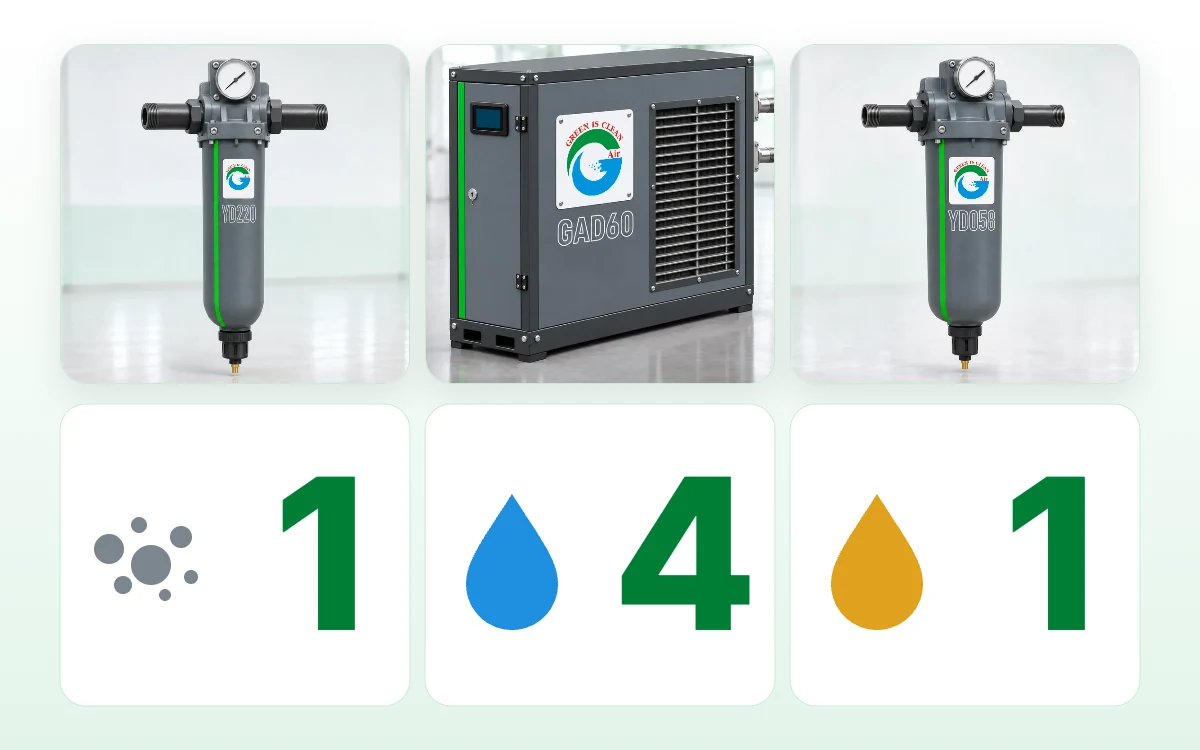
Compressed air quality classes explained
ISO 8573-1 in plain words: three numbers, what they mean and which you need.
Learn more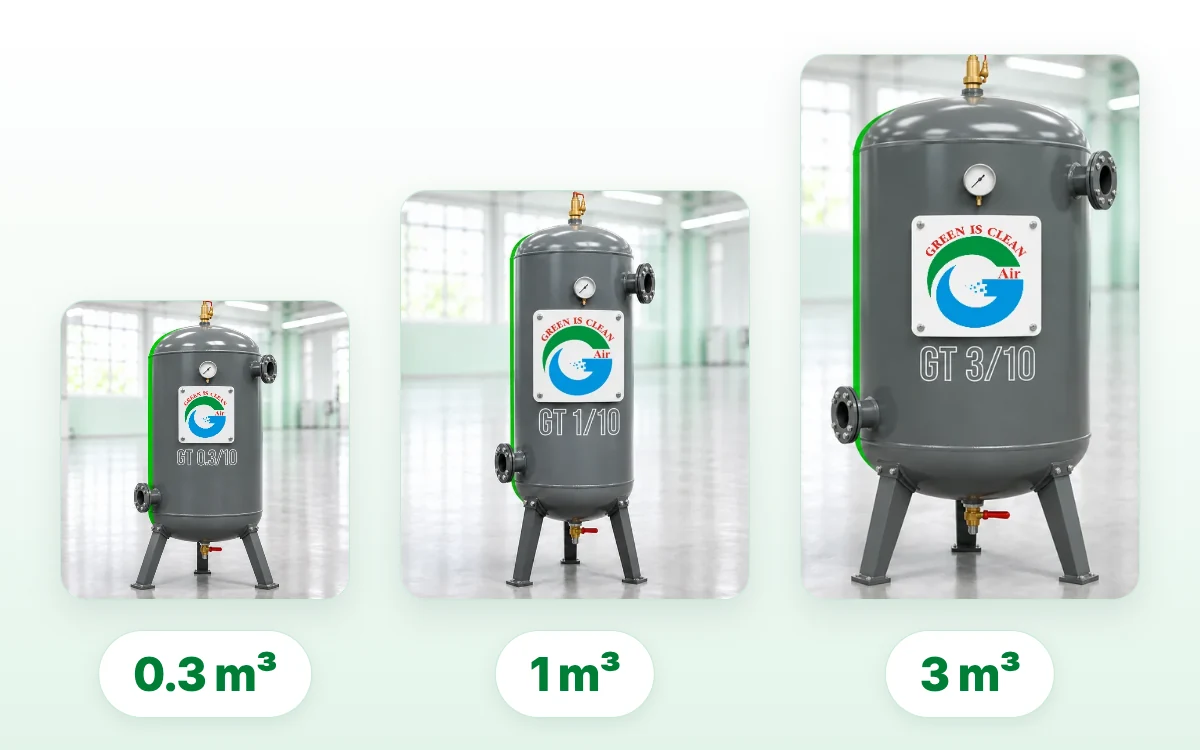
What size air receiver do I need?
The rule, the reason behind it, and when to put the tank somewhere else.
Learn more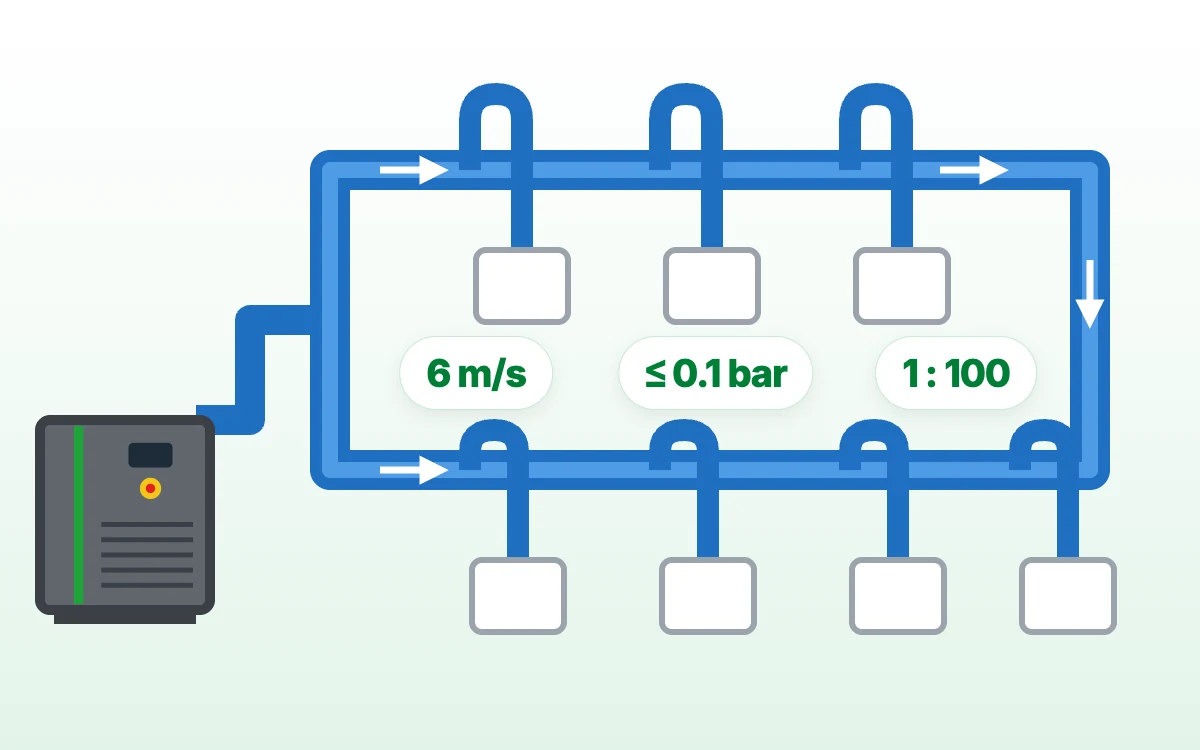
Compressed air pipework: size, ring and slope
The sums that decide the pipe, and the details that keep water out of the machines.
Learn more
Compressor rooms in hot climates
Where the heat goes, how much air the room needs, and why machines trip in August.
Learn moreNot sure which model you need?
Send us your air demand, working pressure and running hours. Our engineers will size the machine and send a written recommendation, no cost, no obligation.