
Nitrogen: generator or cylinders?
What each one costs you, how pure it has to be, and when cylinders still win.
You already own the raw material
If you buy nitrogen in cylinders or as a liquid, you pay for the gas, the container, the delivery, the rental and the empties going back. A generator takes nitrogen out of the compressed air you already make, and after that the main cost is electricity.
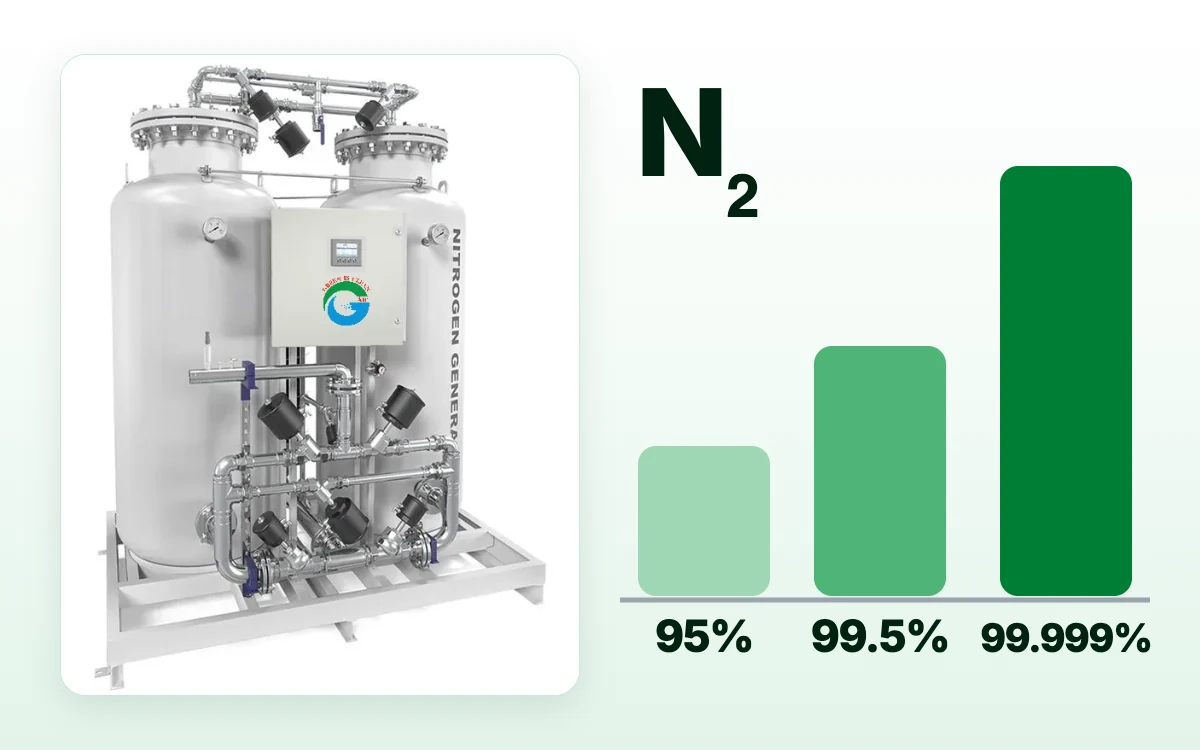
Air is 78% nitrogen, so there is no shortage of raw material. Carbon molecular sieve, known as PSA, reaches up to 99.999%. Membranes are simpler and suit lower purities.
Purity decides everything else. Each extra nine takes more compressed air for the same nitrogen, and specifying 99.999% where 99.5% would do can double the size of the plant. Ask what the process needs before you ask what a supplier can make.
What decides it
How much, how steadily
Steady use all day suits a generator. A few cylinders a month do not.
How pure
99.5% covers most food packaging. Laser cutting of stainless steel and some soldering need more. Check the process, because many specifications carry a number nobody has questioned.
What pressure
A generator delivers at about 7 to 10 bar. Laser assist gas, cylinder filling and injection moulding need a booster after it.
What air you have
It needs clean, dry air without oil. If your compressor has capacity to spare, part of the plant is already paid for.
What a stop costs
A generator does not run out on a Friday night. Keep a few cylinders as a standby and you have both.
How long to pay back
Commonly between one and three years. It depends on your gas bill, so work it out with your own invoices.
PSA or membrane
PSA uses two vessels of carbon molecular sieve that take turns. One holds back oxygen under pressure while the other is cleaned. It covers 95 to 99.999% and is the usual choice for high purity.
A membrane is a bundle of hollow fibres. Oxygen and water vapour pass out through the walls and nitrogen stays in. There are no valves and no sieve, and it starts at once. It suits inerting and tyre filling, where a lower purity is enough.
Both give away part of the air they are fed, and that part grows with purity. The ratio of air to nitrogen is the running cost, so ask for it at your own purity and temperature.
- PSA: 95 to 99.999%
- Membrane: simpler duties, lower purity
- Air to nitrogen ratio asked for at your purity
- Clean, dry, oil-free air before either
- Buffer vessel for peaks
- Oxygen analyser on the outlet
- Room to breathe: nitrogen displaces oxygen
- Standby supply planned
Working out your own saving
Add up a year of invoices: gas, rental, delivery, and the hours spent changing cylinders. That is what it costs today.
Then the generator. Take the air it needs at your purity, at about 6 kW for each m³/min, times your hours and your electricity price. Add the servicing, and the sieve or membrane at the end of its life.
The difference between the two, divided into the price of the plant, is the payback. If it comes out at much more than three years, cylinders may be the right answer and we will say so.
- A year of gas invoices
- Rental and delivery counted
- Time spent changing cylinders
- Gas lost in part-used cylinders
- Feed air at about 6 kW for each m³/min
- Servicing included
- Booster counted if you need pressure
- Payback worked out, not promised
When cylinders are still right
A small, occasional use: a few cylinders a month for a laboratory or a maintenance team.
A very high purity at a very small flow, where the generator would be bigger than the process it feeds.
And as the standby for a generator, because every machine stops one day. A rack of cylinders and a changeover valve is enough.
- A few cylinders a month
- Very small flow at very high purity
- Short project on a temporary site
- Standby for a generator
- No room or no power for a plant
- A process about to change
Frequently asked questions
Is it cheaper to make nitrogen than to buy it?
For steady use, usually. Payback is commonly between one and three years. Work it out with a year of your own invoices.
What purity do I need?
Less than most specifications say. 99.5% covers most food packaging. Laser cutting of stainless steel and some electronics need more. Ask the process, not the catalogue.
How pure can a generator make it?
Up to 99.999% with PSA. The closer to that, the more compressed air it takes for the same nitrogen.
What is the difference between PSA and membrane?
PSA holds back oxygen in a sieve and reaches high purity. A membrane lets oxygen escape through fibres, has no moving parts and suits lower purities.
Can my existing compressor feed it?
If it has the capacity to spare and the air is dry and free of oil. Otherwise the generator comes with a compressor of its own.
What pressure does it come out at?
About 7 to 10 bar. Above that you need a booster, which is common for laser cutting and for filling cylinders.
How much air does it use?
It depends on the purity and the temperature, and it rises steeply towards the top. Ask for the air to nitrogen ratio at your figures, because it is the running cost.
What happens if it stops?
Fit a buffer vessel for minutes and a rack of cylinders for hours, with an automatic changeover.
Is nitrogen dangerous?
It has no smell and it displaces oxygen. A leak in a closed room can make the air unsafe without any warning, so ventilate and fit an oxygen alarm.
What maintenance does it need?
Filters changed on time, valves checked, the oxygen analyser calibrated. The sieve lasts for years if the air going in is clean and dry.
More guides
Choosing a towable compressor
How to size a site machine without guessing.
Learn more
What size air compressor do I need?
Flow first, pressure second and kilowatts last, with the arithmetic shown.
Learn more
Screw or piston compressor?
How long it runs each day decides it, and here is where the line falls.
Learn more
What an air compressor really costs
Why the purchase price is the small number, and what the other two are.
Learn moreNot sure which model you need?
Send us your air demand, working pressure and running hours. Our engineers will size the machine and send a written recommendation, no cost, no obligation.