
Bar, cfm, FAD and kW: the units on a quotation
What each unit means, how to convert it, and which ones hide the answer.
Put both quotations into the same units
Two quotations for the same machine can look completely different, because one is written in m³/min and bar and the other in cfm and psi. Before you compare anything, put both into the same units.
Then check that they describe the same thing. Flow can be free air delivery, piston displacement, normal cubic metres or standard cubic feet, and those are not the same number. Pressure can be gauge or absolute, at the machine or at the point of use. Power can be the motor's rating or what the whole machine takes from the supply.
Once both offers are in m³/min of free air delivery, bar gauge and kW of total input, the comparison usually settles itself.
The conversions
Flow
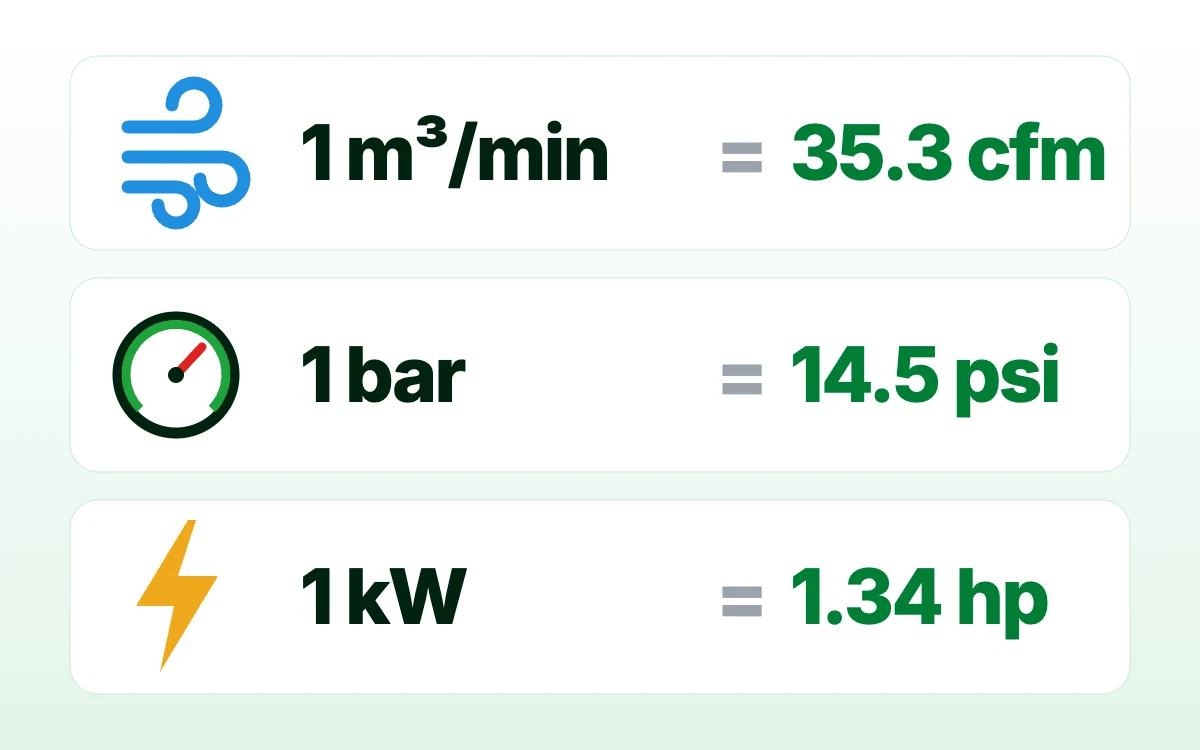
1 m³/min = 35.3 cfm = 16.7 l/s = 60 m³/h. So 100 cfm is about 2.8 m³/min.
Pressure
1 bar = 14.5 psi = 100 kPa = 0.1 MPa. So 8 bar is 116 psi, and 0.8 MPa is the same 8 bar.
Power
1 kW = 1.34 hp. So 50 hp is about 37 kW and 100 hp about 75 kW.
Volume
1 m³ = 1,000 litres = 35.3 cubic feet. A 500 litre receiver is 0.5 m³.
Temperature
Multiply °C by 1.8 and add 32 for °F. So 46 °C is 115 °F, and a +3 °C dew point is 37 °F.
Specific energy
kW for each m³/min. From kW per 100 cfm, divide by 2.83 to get there.
Flow: four names for different things
Free air delivery, FAD, is the air that really comes out, counted as it was when it was drawn in. Measured to ISO 1217 that means 20 °C, 1 bar absolute and dry. This is the figure to compare.
Piston displacement is only what the cylinders sweep. The air delivered is less, because of clearance, leakage and heat, often by a quarter to a third on a small machine.
Normal cubic metres, Nm³, are counted at 0 °C and 1.013 bar, so the same air is a smaller number: 1 m³/min of FAD is about 0.92 Nm³/min. Standard cubic feet have more than one definition, so ask for the temperature and the pressure behind them.
- FAD to ISO 1217: compare this
- Displacement: not delivered air
- 1 m³/min of FAD is about 0.92 Nm³/min
- scfm: ask for the reference conditions
- Flow stated at a pressure, always
- Variable speed: both ends of the range
- Before or after the dryer
- The same pressure in every offer
Pressure and power
Gauge pressure is what the dial shows. Absolute pressure is one bar more. Compressors are quoted in gauge, vacuum pumps in absolute and gas work often in absolute, so write bar g or bar a and nobody has to guess.
Ask where the pressure is measured. A figure at the compressor outlet leaves out the dryer and the filters, which can take half a bar between them.
Motor power is a name and not a measurement. Motors run above it, and fans, pumps and drives take power as well. Total input at your pressure, divided by the FAD, is the figure that decides your bill.
- bar g on the dial, bar a is one more
- Vacuum always in absolute
- Pressure after the dryer and the filters
- Total input power, not the motor plate
- kW for each m³/min at your pressure
- Tolerances stated
- Voltage and frequency of your supply
- Starting current on a weak supply
The rest of the sheet
Noise in dB(A) is usually given at one metre, with a tolerance. Sound power, written LwA, is a larger number for the same machine, so make sure both offers use the same one.
Dew point without the word pressure may be an atmospheric one, which looks far better than it is. A pressure dew point of +3 °C at 7 bar is about −23 °C at atmospheric pressure, and the air is exactly the same.
Dimensions and weight are for the bare machine. Ask for the space it needs with its doors open.
- Noise at one metre, or sound power
- Pressure dew point, not atmospheric
- Ambient rating in °C
- Dimensions with the doors open
- Service intervals in hours
- What is not included
Frequently asked questions
How many cfm is 1 m³/min?
35.3 cfm. So 3 m³/min is 106 cfm, 5 m³/min is 177 cfm and 10 m³/min is 353 cfm.
How many psi is 8 bar?
116 psi. 7 bar is 102 psi and 10 bar is 145 psi.
How many kW is 50 hp?
About 37 kW. 10 hp is 7.5 kW, 20 hp is 15 kW and 100 hp is 75 kW.
What is FAD?
Free air delivery: the air that comes out of the compressor, counted as it was when it was drawn in. It should always be stated with the pressure it was measured at.
What is the difference between cfm and scfm?
cfm on a compressor sheet is normally free air at the inlet conditions. scfm is the same air worked out for a standard temperature and pressure, and there is more than one standard. Ask which.
What is Nm³?
A cubic metre counted at 0 °C and 1.013 bar. 1 m³ of FAD is about 0.92 Nm³. Gas and nitrogen are usually sold in Nm³.
What is the difference between bar g and bar a?
Gauge pressure starts at the air around us and absolute pressure at nothing. 7 bar g is 8 bar a.
What is MPa?
A megapascal, which is 10 bar. 0.7 MPa is 7 bar and 1 MPa is 10 bar.
What is specific energy?
The kW a machine takes for each m³/min it delivers, at a stated pressure. It is the figure that lets you compare two machines.
Why do two sheets give a different flow for the same machine?
Usually the pressure: one is at 7 bar and the other at 8. Then look at the standard, at the speed range on variable speed machines, and at whether a built-in dryer is counted.
More guides
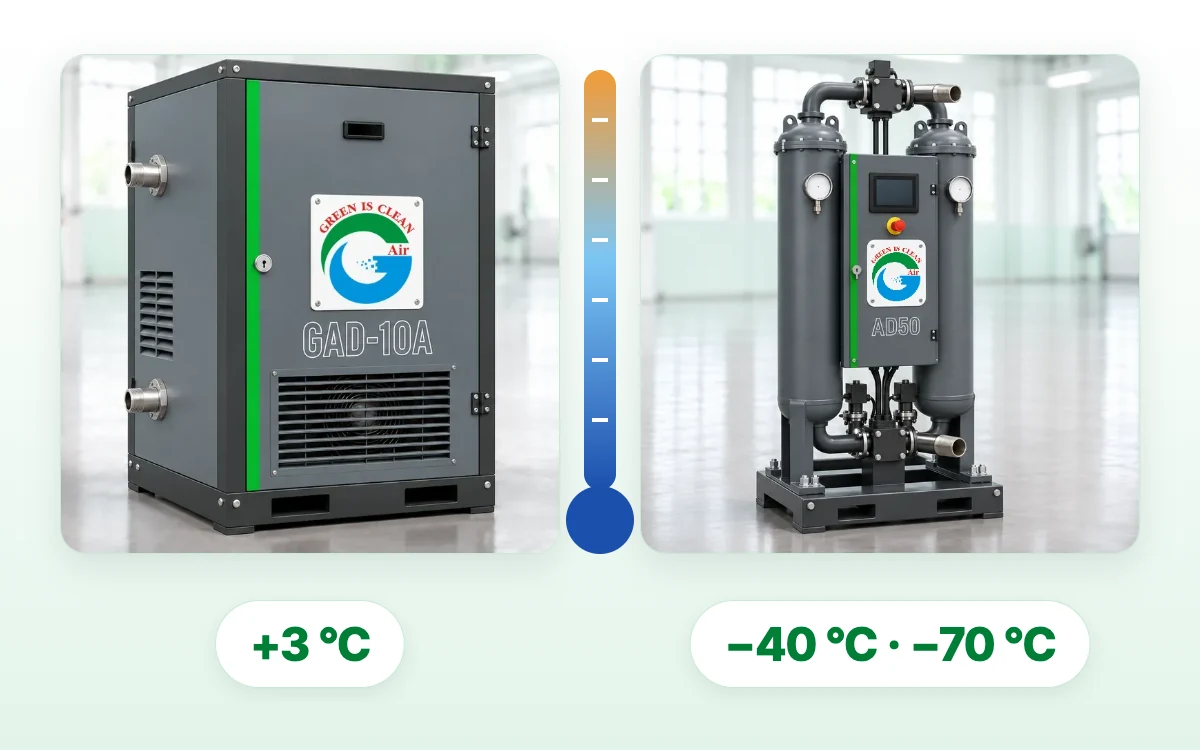
Which air dryer do I need?
Dew point in plain words, and the one temperature that decides the type.
Learn more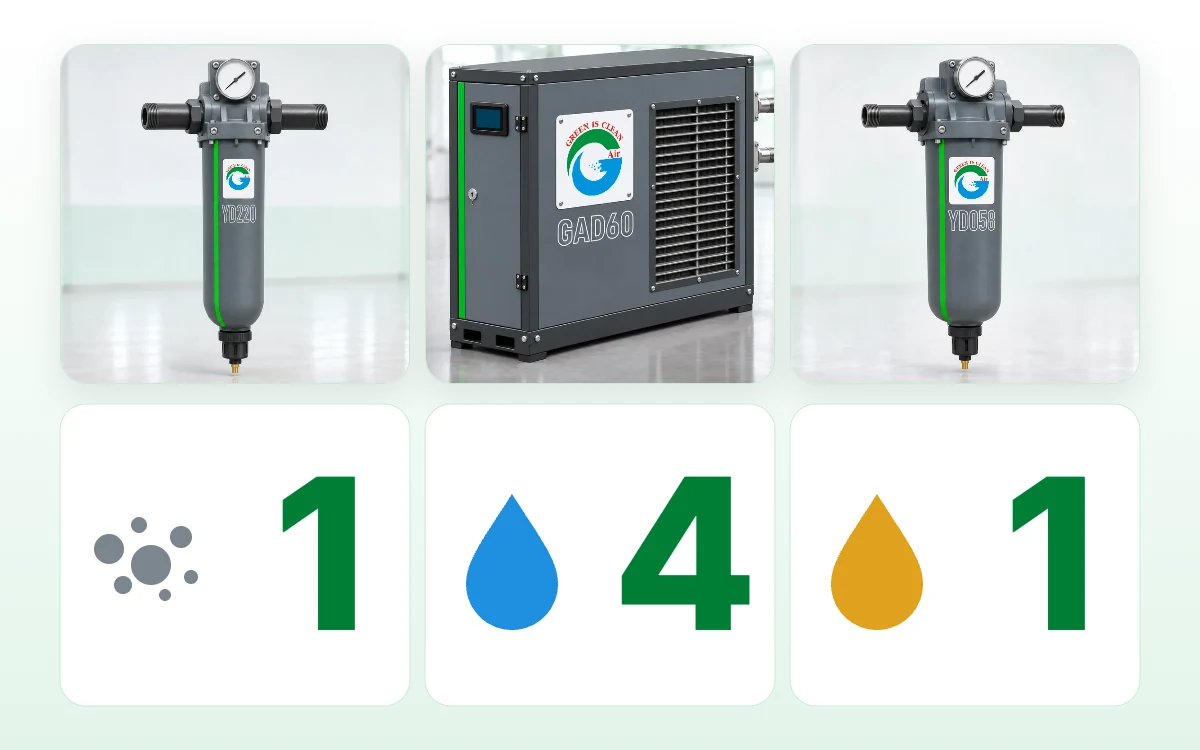
Compressed air quality classes explained
ISO 8573-1 in plain words: three numbers, what they mean and which you need.
Learn more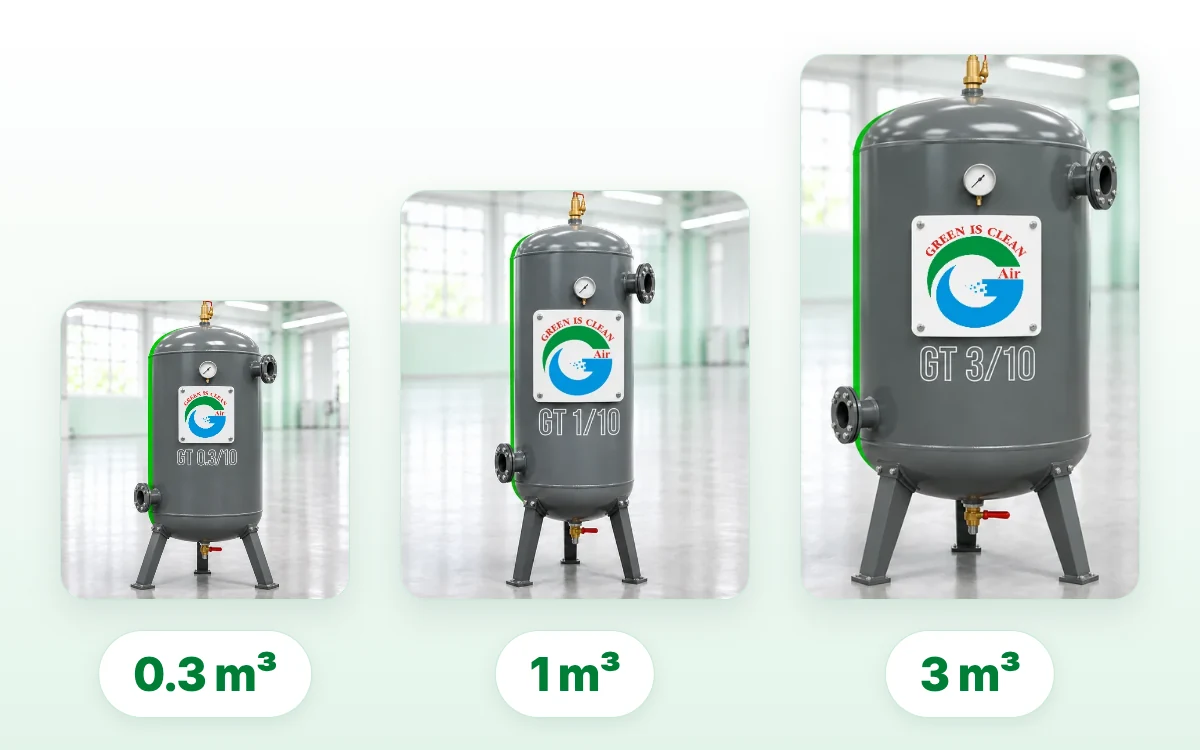
What size air receiver do I need?
The rule, the reason behind it, and when to put the tank somewhere else.
Learn more
Compressed air pipework: size, ring and slope
The sums that decide the pipe, and the details that keep water out of the machines.
Learn moreNot sure which model you need?
Send us your air demand, working pressure and running hours. Our engineers will size the machine and send a written recommendation, no cost, no obligation.