
Compressed air leaks: find them and count the cost
What a hole costs, how to measure your own leaks in an evening, and what to repair first.
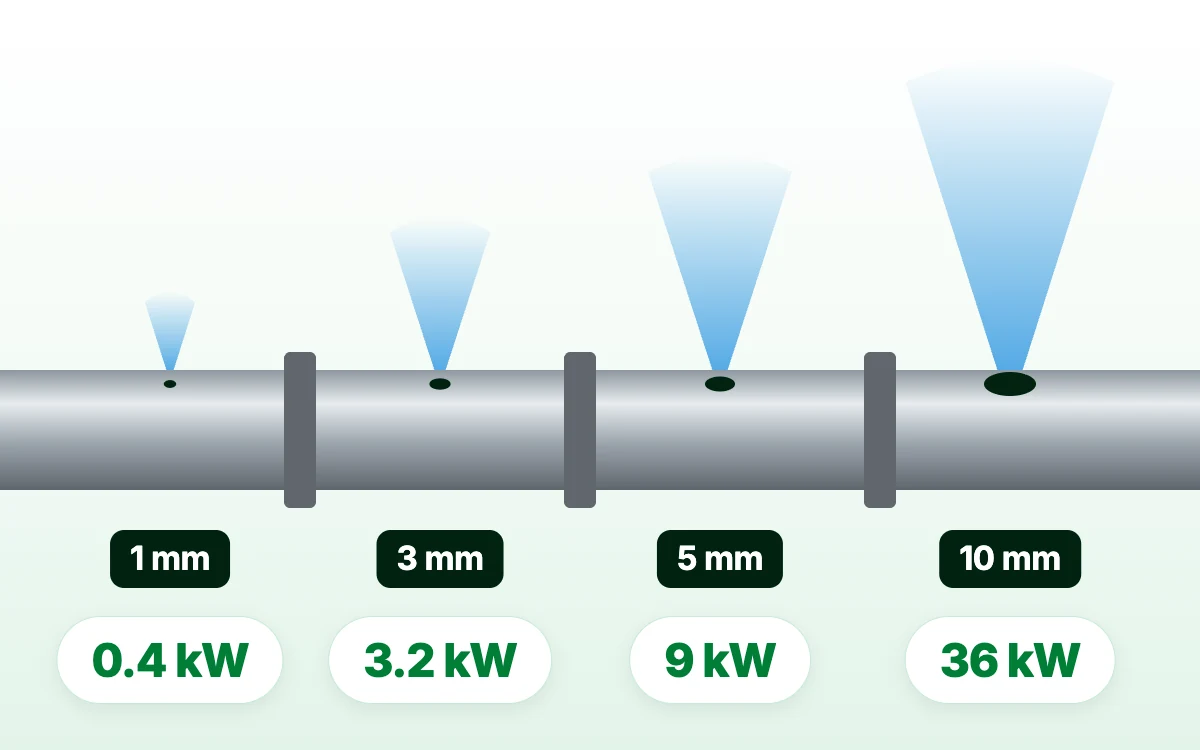
The largest waste nobody sees
Leaks are the largest waste in most compressed air systems. A plant nobody has surveyed typically loses 20 to 30% of everything it makes, and leaks work twenty four hours a day whether the factory does or not.
They are ignored because they are invisible and because air feels free. It is not. A 3 mm hole at 7 bar lets out about 0.53 m³/min. At 6 kW for each m³/min that is 3.2 kW, all the time the system is under pressure, and over 8,000 hours it is about 25,600 kWh.
Few things in a factory pay back as fast. Most leaks are at joints, hoses and couplings, most are cured with a spanner or a new seal, and the waste stops the same minute.
Where the leaks are
Couplings and hoses
Quick couplings, hose tails and worn hoses are the commonest leaks, and the cheapest to put right.
Threads and valves
Old threads, sealing tape that has hardened, and valve stems that weep.
Filters and regulators
Bowls that have lost a seal, and drains that no longer close.
Condensate drains
A drain stuck open passes air all day and sounds as if it is doing its job.
Cylinders and tools
Worn seals let air past on every stroke. Idle machines leak as well, so shut them off.
Lines nobody uses
A pipe left under pressure to a machine that has not run for a year is a leak with a long tail.
Measure your own leaks in an evening
You need a stopwatch and a quiet plant. With nobody using air, let the compressor bring the system to pressure and time how long it runs loaded and how long it rests, over ten cycles.
Leakage is the loaded time divided by the loaded and resting time together. A compressor of 10 m³/min that loads for 90 seconds and rests for 210 is making air for 30% of the time, so 3 m³/min is leaking.
At 6 kW for each m³/min those leaks take 18 kW. Over the nights and weekends alone, about 5,000 hours a year, that is 90,000 kWh for nothing at all.
- Done when nothing is using air
- Blow offs and open drains shut first
- Ten cycles timed
- Loaded time divided by total time
- Multiplied by the compressor's flow
- Multiplied by 6 kW for each m³/min
- Repeated after the repairs
- Figure written where everybody sees it
What a hole costs
The figures below are for a clean round hole at 7 bar, worked out the way the leak calculator on our sizing tools page does it. A real leak, through a cracked seal or a loose thread, passes somewhat less for the same size.
Flow rises with the area, so a hole twice as wide passes four times as much. And ten leaks you cannot hear are usually worse than the one you can.
It also rises with pressure. Taking one bar off a 7 bar system cuts every leak in the building by about an eighth, the same day, with no spanner at all.
- 1 mm: about 0.06 m³/min, 0.4 kW
- 2 mm: about 0.24 m³/min, 1.4 kW
- 3 mm: about 0.53 m³/min, 3.2 kW
- 5 mm: about 1.5 m³/min, 9 kW
- 10 mm: about 5.9 m³/min, 36 kW
- Multiply the kW by the hours under pressure
Keep them from coming back
One survey is worth a few months. Leaks return at about the rate you stop looking, so walk the plant with an ultrasonic detector two or three times a year, tag what you find and take the tag off when it is repaired.
Shut off what is not used. A valve on every branch, closed at the end of the shift, stops the leaks you have not found yet.
Fit drains that do not pass air, and choose couplings for the seal rather than for the price.
- Ultrasonic survey two or three times a year
- Every leak tagged, repaired and crossed off
- Branch valves closed after the shift
- Drains that close fully
- Couplings chosen for the seal
- Pressure as low as the work allows
- Night consumption recorded
- One person responsible for the figure
Frequently asked questions
How much air does a typical plant lose?
20 to 30% where nobody has looked. A plant that surveys and repairs can hold it at about 10%.
How do I measure my leaks?
With the plant quiet, time the compressor loading and resting. Loaded time divided by total time, multiplied by the compressor's flow, is what is leaking.
How much does a 3 mm leak cost?
About 0.53 m³/min at 7 bar, which is about 3.2 kW. Multiply by the hours the system is under pressure and by your own electricity price.
How do I find leaks?
An ultrasonic detector in a working plant, or your ears and soapy water in a quiet one. Begin at the hoses and couplings.
Can I find them while the factory is running?
Yes, with an ultrasonic detector. It hears the hiss of a leak above the noise of machines.
Which leaks should I repair first?
The biggest ones that need no shutdown: hoses, couplings and drains. Then plan the rest for the next stop.
Does lowering the pressure reduce leaks?
Yes. One bar off a 7 bar system cuts them by about an eighth, and saves about 7% on the air you still use.
How often should I survey?
Two or three times a year. Leaks come back at about the rate you stop looking.
Will a new compressor solve it?
No. It will feed the leaks. Repair them first, and you may find the compressor you have is large enough.
Are condensate drains really that important?
Yes. A timed drain opens whether there is water or not, and one that sticks open is as bad as a hole. A drain that opens on level wastes almost nothing.
More guides
Air compressor troubleshooting
The fault you can see, what usually causes it, and what to check before calling anyone.
Learn more
Variable speed compressors explained
What VSD actually saves, and when it saves nothing at all.
Learn more
How a rotary screw compressor works
Two rotors, one continuous flow, and why it replaced the piston machine.
Learn more
Oil-lubricated compressors: what the oil is doing
Why oil is in there, what it costs you, and when to go oil-free.
Learn moreNot sure which model you need?
Send us your air demand, working pressure and running hours. Our engineers will size the machine and send a written recommendation, no cost, no obligation.