
Compressor rooms in hot climates
Where the heat goes, how much air the room needs, and why machines trip in August.
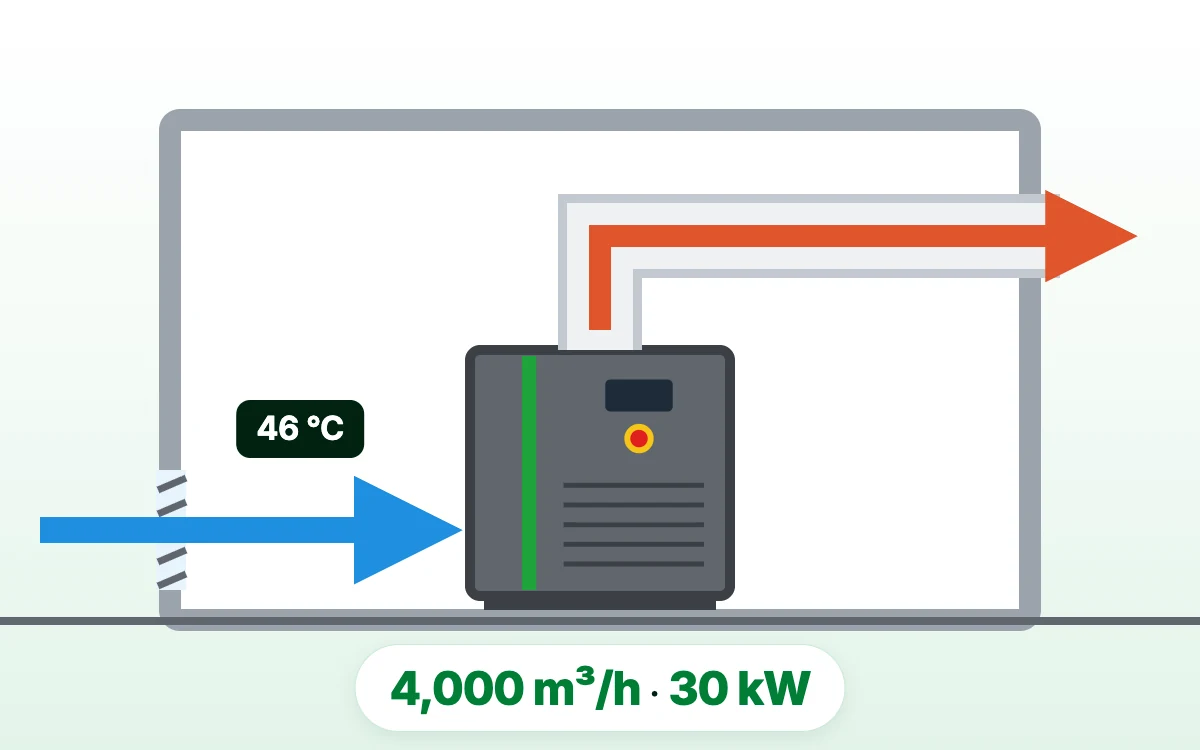
Every compressor is a heater
Almost all of the electricity a compressor takes leaves it as heat. A 45 kW machine is a 45 kW heater that also makes air, and if the room cannot lose that heat the machine breathes it in again. Too little ventilation is the main cause of summer trips.
The figure to remember is about 4,000 m³ of cooling air an hour for every 30 kW installed, so a 45 kW machine needs roughly 6,000 m³/h. It has to come in cool and low and leave hot and high, and the two must not meet.
Our standard build is rated to 46 °C ambient and a high ambient package takes it to 52 °C. Both mean the air at the machine's intake, not the temperature in the weather forecast. A closed room can easily be 10 °C hotter than the street.
What heat does to the machine
The oil ages
As a rule of thumb every 10 °C hotter halves the life of the oil. It is why one plant changes oil on schedule and another cooks it.
The output falls
Hot air is thin. Between 30 °C and 45 °C the same machine draws in about 5% less air by weight.
The dryer gives up
A refrigerant dryer rated at 25 °C loses about a third of its capacity at 45 °C, and it usually stands in the same room.
The electronics trip first
Drives and controllers stop before the airend does. A drive cabinet filter full of dust is a common cause.
The cooler blocks
Dust and hot air together close a cooler from the inside out. Cleaning it is free and it is the first thing to look at.
Nobody goes in
A room at 55 °C does not get its weekly check, and the small fault becomes the large one.
How much air, worked out
Add the motor power of everything that runs together. Two 75 kW machines, both running, are 150 kW.
150 kW at 4,000 m³/h for every 30 kW is 20,000 m³/h. Through a louvre at 3 metres a second that is an opening of about 1.9 m², measured clear, after the blades and the mesh have been taken off.
Ducting the hot outlet outside keeps the room close to the outside temperature. Check that the machine's own fan can push through the duct, because most allow very little resistance before they need help from another fan.
- About 4,000 m³/h for every 30 kW
- Roughly 6,000 m³/h for 45 kW
- About 20,000 m³/h for 150 kW
- Inlet low, outlet high, on opposite walls
- Inlet on the shaded side
- Louvre area counted clear
- Duct resistance checked against the fan
- Dryer heat counted as well
Mistakes we meet every summer
The hot air comes back. A machine that blows at a wall one metre away is breathing its own exhaust, and no rating will save it.
The inlet is beside something worse: a generator, a boiler flue, a road, a cooling tower. The intake filter and the cooler collect all of it.
The room was right for one machine and now holds three. Ventilation is hardly ever part of the order when the third one is bought.
- Hot outlet facing a wall
- Inlet beside a generator or a flue
- Louvres painted shut or blocked with cartons
- Room fan on a switch nobody turns on
- Third machine, same opening
- Dryer standing in the compressor's exhaust
- Door left open instead of a duct
- No thermometer in the room
Air cooled or water cooled
Below about 90 kW air cooling is normal, as long as the room can lose the heat. Above that, water cooling takes the heat out of the room altogether, and in a Gulf summer that is often the difference between a machine that runs and one that trips at the same time every afternoon.
Water cooling asks for water of a known quality and a cooling tower or a closed circuit, and those need care of their own. The heat can also be used. Hot water for washing or for a process is the cheapest there is.
Where there is no good room at all, a compressor station in a container brings its own, with ventilation, filtration and the electrical panel sized for the heat the machine really gives off.
- Air cooled below about 90 kW
- Water cooled where the room cannot lose the heat
- Water quality checked before it is chosen
- Heat recovery priced at the same time
- Container where there is no room
- Shade and dust protection outdoors
- Sound checked with the louvres open
- Decided with the building, not after it
Frequently asked questions
How much ventilation does a compressor room need?
About 4,000 m³/h of cooling air for every 30 kW installed. A 45 kW machine needs roughly 6,000 m³/h and two 75 kW machines about 20,000.
How hot can a compressor room be?
Our standard build is rated to 46 °C and the high ambient package to 52 °C, measured at the machine's intake. Cooler is always better for the oil and the dryer.
Why does my compressor trip only in summer?
Almost always airflow. Check the cooler, the inlet, whether the hot air comes back, and whether the room has enough ventilation, before suspecting the machine.
Can I put the compressor outside?
Under a roof, in shade and with the intake protected from dust and rain, if the machine is built for it. A container station is the usual way to do it properly.
How much heat does a compressor give off?
Nearly all of the power it takes. A 45 kW machine gives off about 45 kW, as a heater would.
Can I use that heat?
Yes. Warm air can heat a hall in winter, and a heat exchanger in the oil or the cooling water makes hot water for washing or for a process.
Air cooled or water cooled?
Air cooled below about 90 kW unless the room cannot lose the heat. Above that, water cooling takes the heat out of the room entirely.
How much space should I leave round it?
One metre clear on the service side, and whatever the inlet and the outlet need to breathe without meeting each other.
Does an air conditioned room help?
It is an expensive way to remove heat that a louvre and a duct can remove for almost nothing. Cool the drive cabinets and ventilate the room.
Where should the dryer stand?
Out of the compressor's hot exhaust, with its own cool air and a drain. In a hot room choose one rated for the temperature it will really see.
More guides
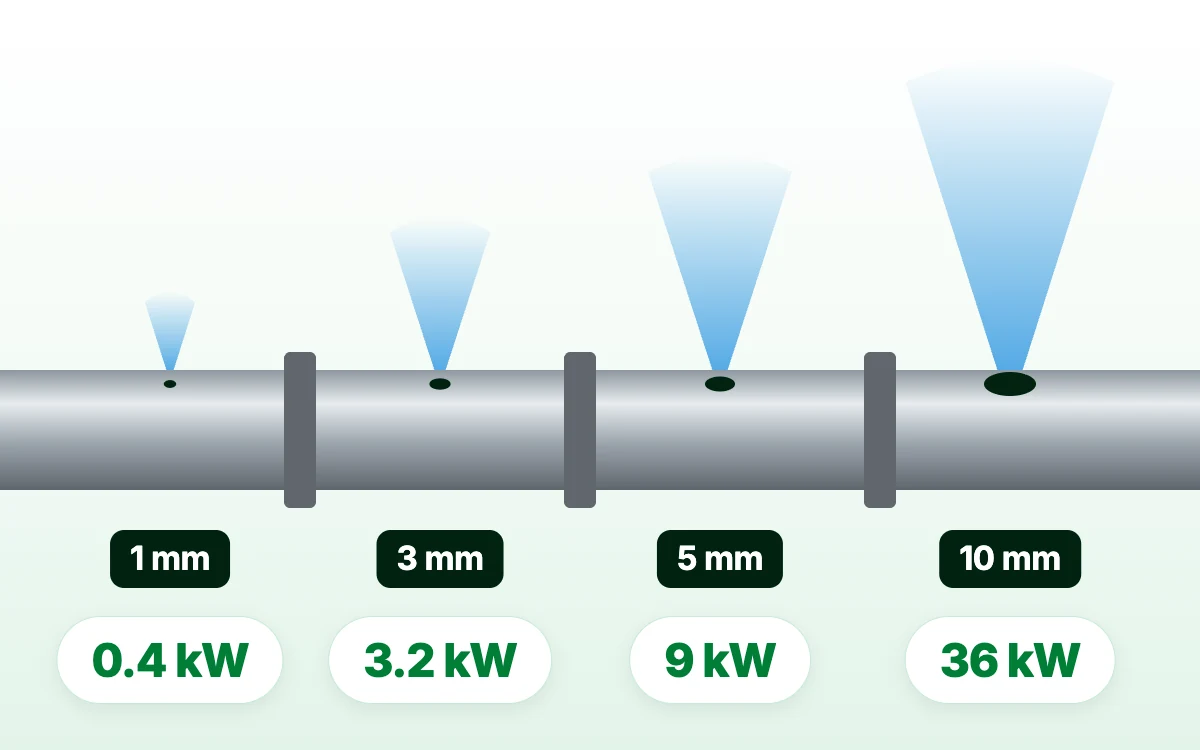
Compressed air leaks: find them and count the cost
What a hole costs, how to measure your own leaks in an evening, and what to repair first.
Learn more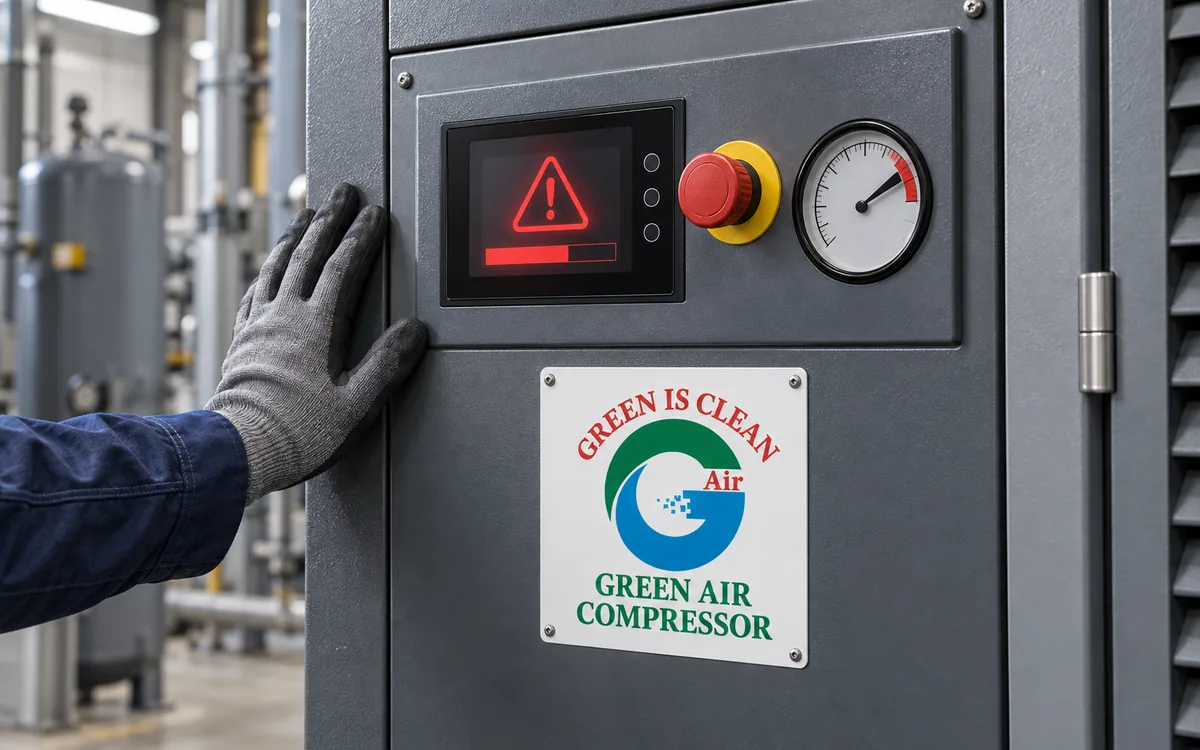
Air compressor troubleshooting
The fault you can see, what usually causes it, and what to check before calling anyone.
Learn more
Variable speed compressors explained
What VSD actually saves, and when it saves nothing at all.
Learn more
How a rotary screw compressor works
Two rotors, one continuous flow, and why it replaced the piston machine.
Learn moreNot sure which model you need?
Send us your air demand, working pressure and running hours. Our engineers will size the machine and send a written recommendation, no cost, no obligation.