
Desiccant air dryers
Dew points down to −70 °C for critical and outdoor pipework.
Technical data
- Free air delivery
- 6.7 – 141.7 m³/min
- Weight
- 285 – 4,400 kg
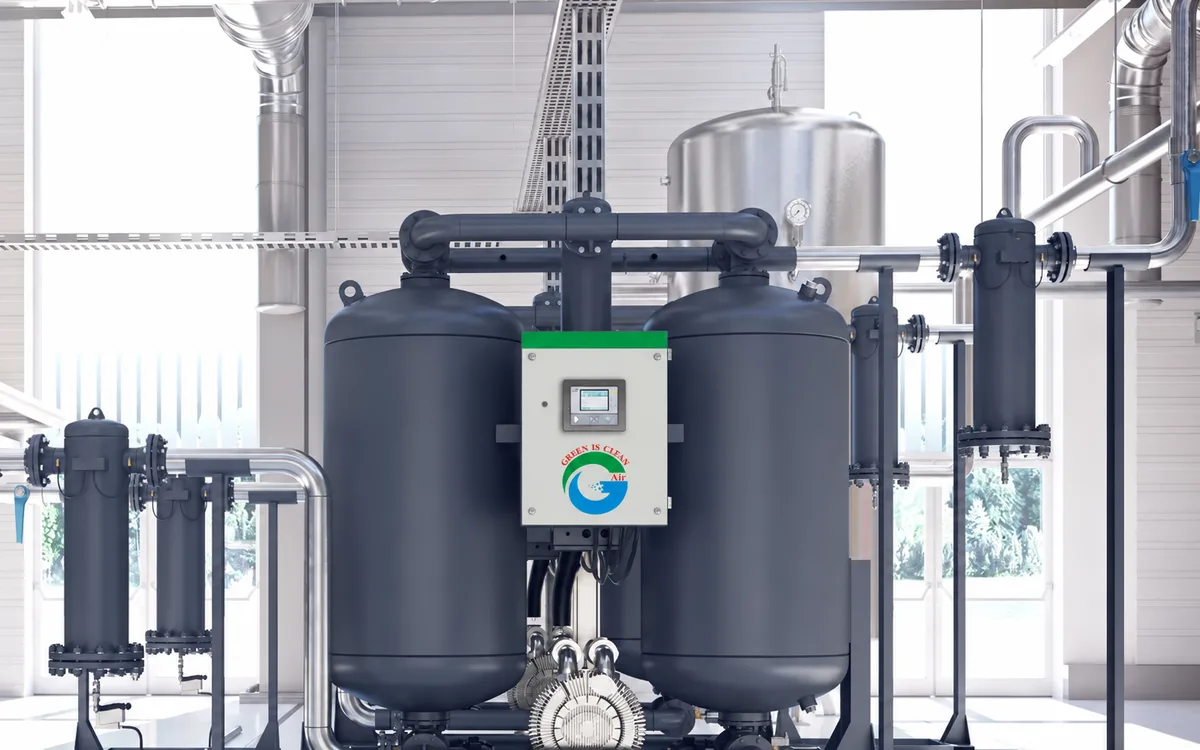
Overview
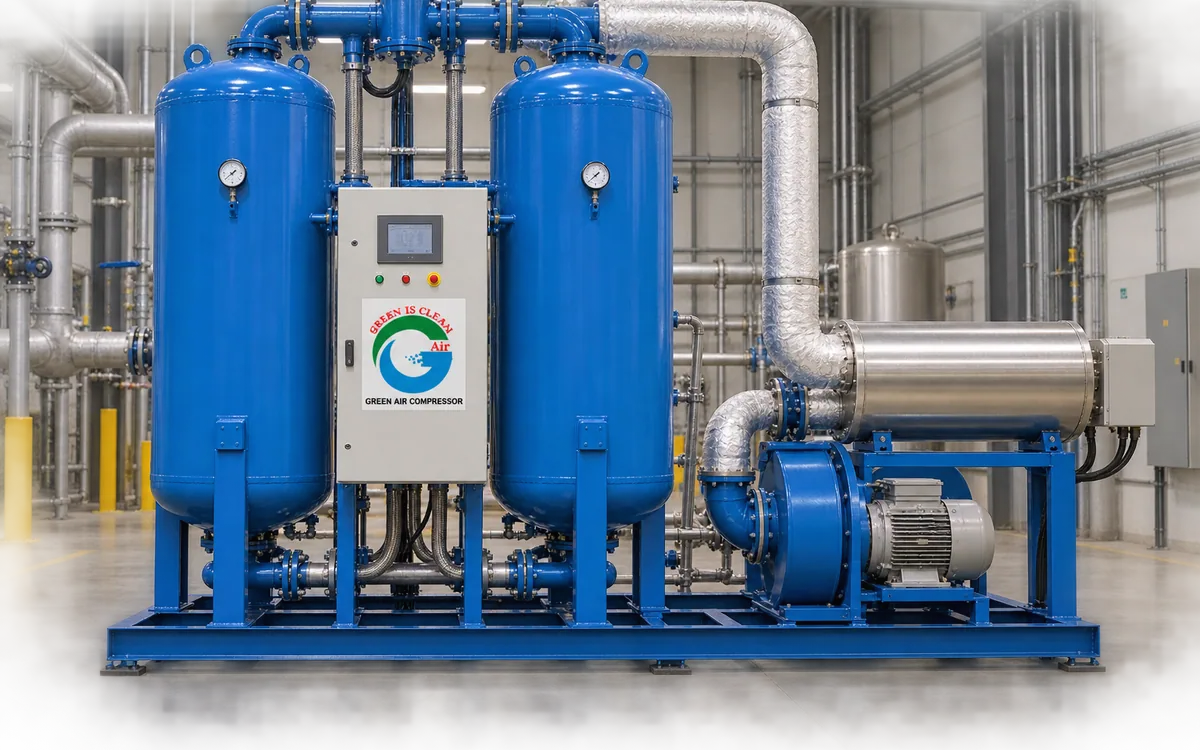
Desiccant dryers pass air over a bed of adsorbent material that pulls the water vapour out. Two towers alternate: one dries while the other regenerates. This gets you well below freezing: typically −40 °C, and −70 °C where the process demands it.
They cost more to run than refrigerant dryers, so the honest advice is to use them only where you need them. Outdoor pipework, cold stores, instrument air, pharmaceutical processes and anything blowing directly onto product are the usual cases.
Key benefits
−40 °C or −70 °C dew point
Selectable to the standard your process or your customer's audit actually requires.
Heated regeneration option
Blower-purge and heated designs cut purge air loss from 15% down to 2 – 3%, which dominates the running cost.
Dew point control
Dew-point-dependent switching only regenerates when needed instead of on a fixed timer.
Long desiccant life
Correct pre-filtration and even flow distribution give three to five years of bed life rather than eighteen months.
How it is built
Two towers of desiccant. One dries the air while the other is regenerated, and they change over on a cycle so the supply never stops. That is the whole principle and everything else is about doing it without wasting air.
Heatless designs use a share of the dried air to regenerate the offline tower. Heated and blower regenerated designs use much less air and more electricity, which is the trade worth doing arithmetic on before buying.
The valves and the switching are the parts that decide reliability. They operate thousands of times a year, so they are the parts we specify and stock carefully.
- Twin tower design with continuous supply
- Dew points to minus forty and minus seventy
- Heatless, heated or blower regenerated
- Purge air kept to the minimum for the design
- Dew point dependent switching available
- Prefilter and afterfilter supplied
- Sized for high ambient temperatures
- Volt free alarm contacts
What the controller does
Dew point dependent switching is the feature worth paying for. Instead of changing towers on a fixed timer, the dryer changes when the desiccant has actually reached its limit, which on a partly loaded plant saves a great deal of purge air.
The screen shows the dew point being achieved, the tower in service and the time or dew point remaining. An auditor asks for the first of those and a plant engineer reads the other two.
Alarms are raised on high dew point and on valve failure, and both are available as volt free contacts for the plant system.
- Dew point dependent switching
- Achieved dew point shown on screen
- Tower in service and time remaining
- High dew point alarm
- Valve failure alarm
- Purge air minimised automatically
- Volt free contacts for plant alarms
- Service countdown in hours
Parts and service kits
Valve service, muffler replacement and a desiccant change are the three items. The first two are frequent and cheap, the third is infrequent and is what the cost of ownership rests on.
Desiccant life depends far more on what reaches the dryer than on the dryer itself. Oil carryover kills a bed quickly, which is why the prefilter is part of the specification rather than an accessory.
We keep valve kits and mufflers on the van. A dryer that is passing air but not drying it is usually a valve, and it is usually fixed on the same visit.
- Valve service kits by interval
- Mufflers replaced on the schedule
- Desiccant change every three to five years
- Prefilter elements to protect the bed
- Dew point verified after service
- Kits held in local stock
- Serviced with the compressor on one visit
- Fixed price under a service plan
Model range
- Connection 1½ in
- 6.7 m³/min (400 m³/h)
- Weight
- 285 kg
- Dimensions L x W x H
- 2160 × 825 × 530 mm
- Connection 2 in
- 12.5 m³/min (750 m³/h)
- Weight
- 520 kg
- Dimensions L x W x H
- 2117 × 970 × 620 mm
- Connection 2 in
- 16.7 m³/min (1,000 m³/h)
- Weight
- 828 kg
- Dimensions L x W x H
- 2131 × 1440 × 1035 mm
- Connection 3 in
- 33.3 m³/min (2,000 m³/h)
- Weight
- 1,500 kg
- Dimensions L x W x H
- 2185 × 1928 × 1460 mm
- DN100 PN16
- 55.0 m³/min (3,300 m³/h)
- Weight
- 2,300 kg
- Dimensions L x W x H
- 2349 × 2132 × 1652 mm
- DN150 PN16
- 93.3 m³/min (5,600 m³/h)
- Weight
- 2,950 kg
- Dimensions L x W x H
- 2535 × 2438 × 1791 mm
- DN150 PN16
- 141.7 m³/min (8,500 m³/h)
- Weight
- 4,400 kg
- Dimensions L x W x H
- 2344 × 2677 × 1945 mm
FAD measured to ISO 1217 Edition 4, Annex C and E at 1 bar a intake, 20°C, 0% humidity. Noise measured to ISO 2151 in free field conditions, tolerance ± 3 dB(A). Water-cooled versions of every model are available. Ask us for their sheet.
Frequently asked questions
When do I actually need a desiccant dryer?
When pipework runs outdoors, through a cold store or in an unheated area, or when the process needs a dew point below zero, instrument air, pharmaceutical, powder handling.
How does it work?
Two towers of adsorbent alternate: one dries the air while the other regenerates. You get a continuous supply because they swap before the working bed is saturated.
What dew point can I get?
−40 °C as standard, −70 °C where the process or an audit demands it. Deeper drying costs more to run, so specify what you need rather than the deepest available.
What does purge air mean?
The compressed air used to regenerate the offline tower. A heatless dryer uses 15–20% of your output for this, which is the dominant running cost.
How do I reduce the purge loss?
Blower-purge and heated designs bring it down to 2–3% by using a fan and heater instead of your compressed air. Above about 700 m³/h the extra capital pays back quickly.
What is dew-point-dependent switching?
The dryer regenerates when the bed actually needs it rather than on a fixed timer. On a plant with variable demand it saves a substantial share of the purge.
How long does the desiccant last?
Three to five years with correct pre-filtration and even flow distribution. Oil carry-over from a worn separator kills a bed in about eighteen months.
Why is my desiccant dusting into the line?
Bed attrition from pressure surges or too-rapid switching. An after-filter catches it, but repeated dusting means the switching or the flow distribution needs looking at.
Can I have both types on one system?
Yes, and it is often the cheapest arrangement: a refrigerant dryer on the general ring main and a small desiccant dryer only on the line that needs a low dew point.
What maintenance does it need?
Valve service, filter changes, dew point measurement and a bed condition check. Valves are the wearing part on a twin-tower dryer, not the desiccant.
Related products
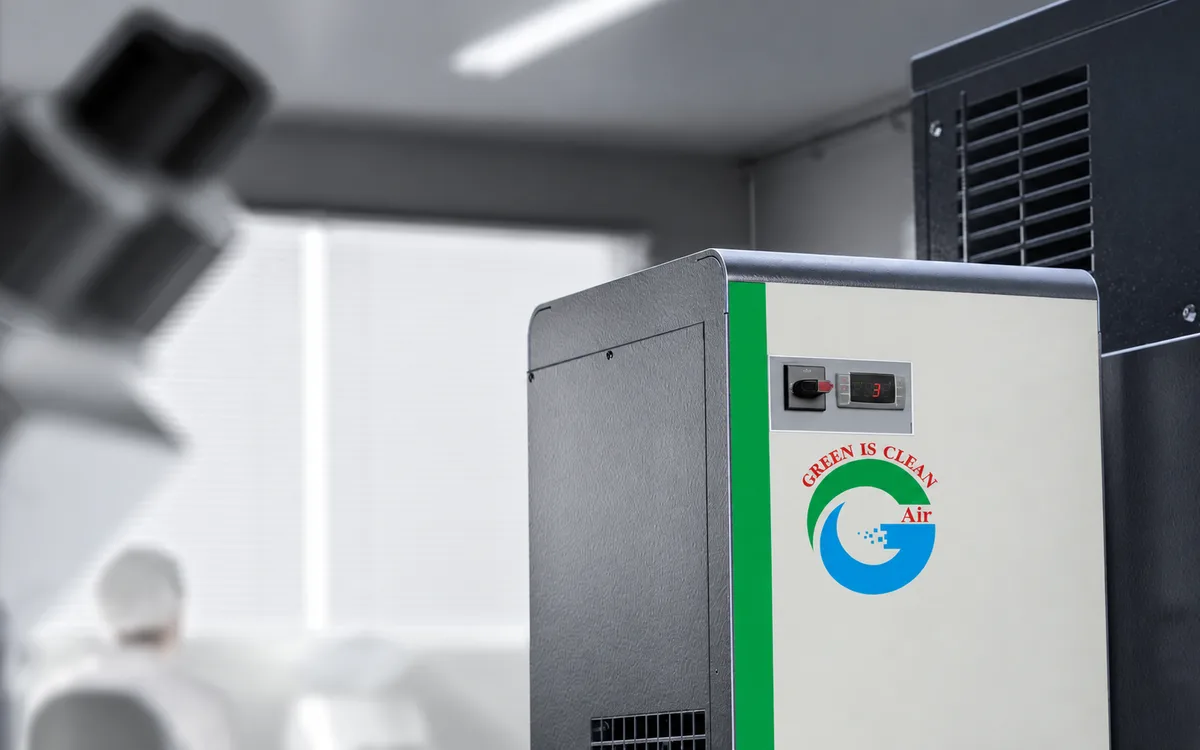
Refrigerant air dryers
The standard, low-cost way to reach a +3 °C pressure dew point.
- Free air delivery
- 10.0 – 383.3 m³/min
- Working pressure
- 13 – 16 bar g
- Motor power
- 1 – 32 kW
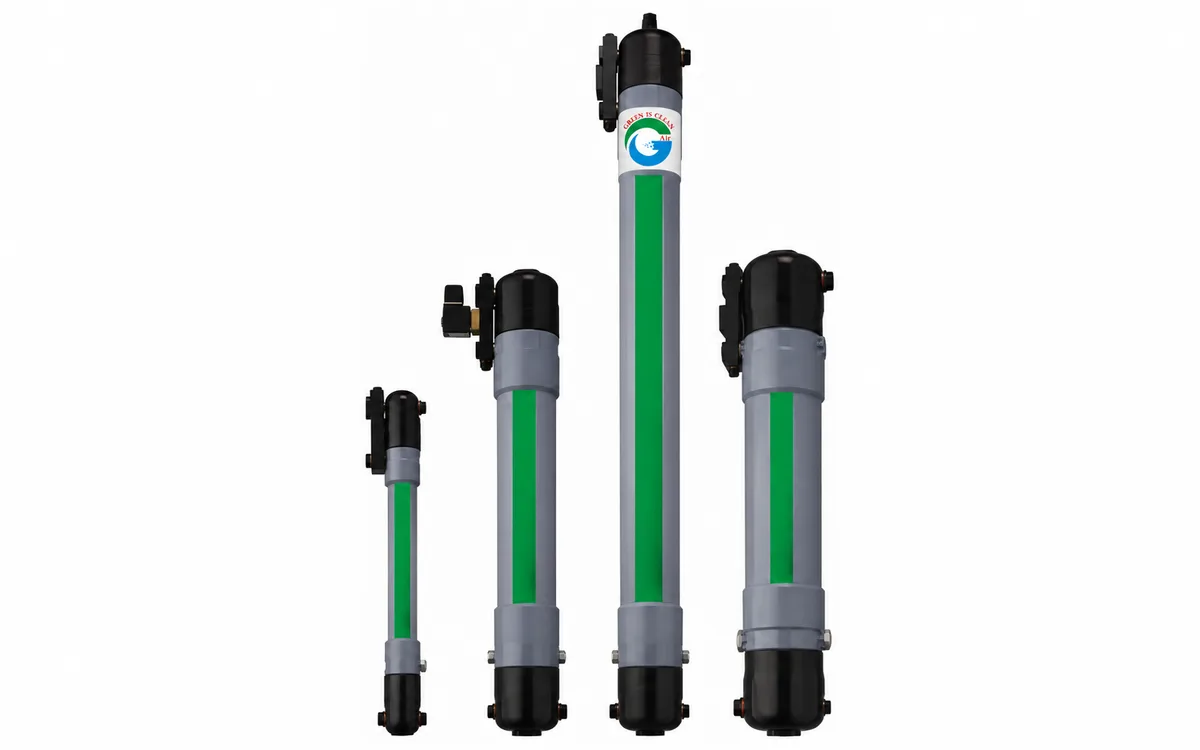
Membrane air dryers
Silent, power-free drying for small flows and point-of-use.
Learn more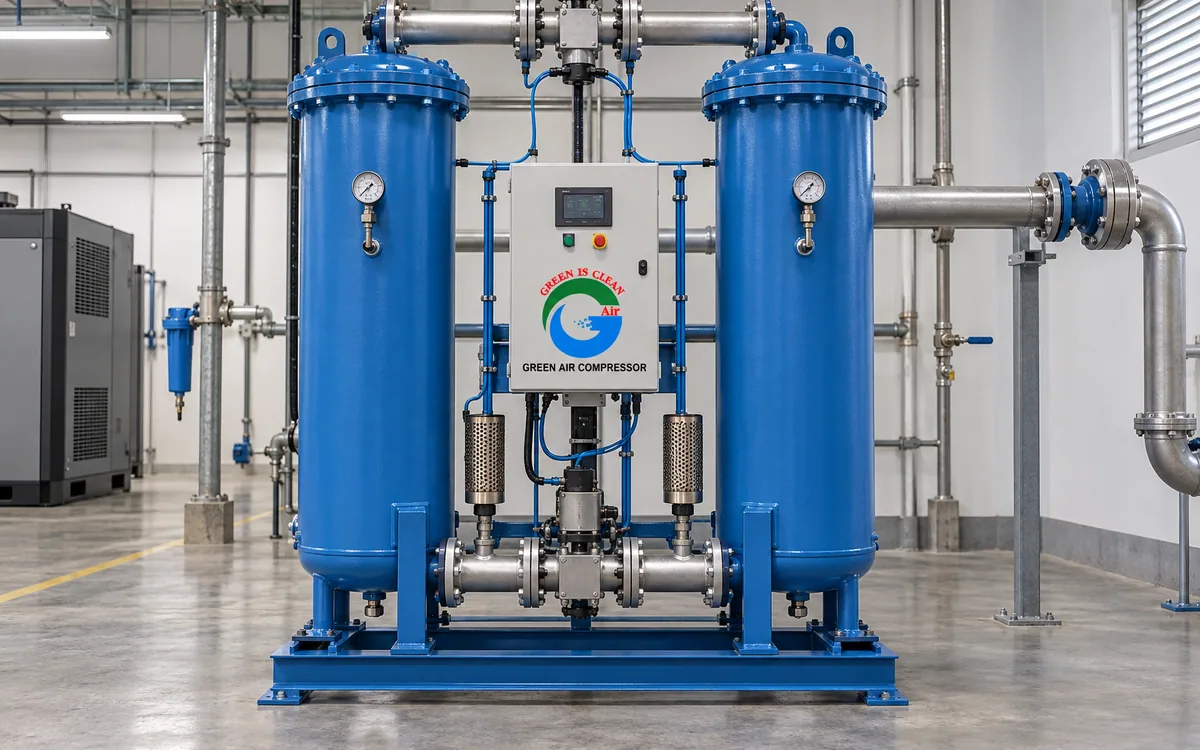
Heatless adsorption dryers
Minus 40 °C dew point with no heater. Simple, reliable, uses purge air.
- Free air delivery
- 1.4 – 80.0 m³/min
Heated and blower purge adsorption dryers
Minus 40 °C with two per cent purge or none at all. For large flows.
Learn moreNot sure which model you need?
Send us your air demand, working pressure and running hours. Our engineers will size the machine and send a written recommendation, no cost, no obligation.