
Oil-lubricated compressors: what the oil is doing
Why oil is in there, what it costs you, and when to go oil-free.
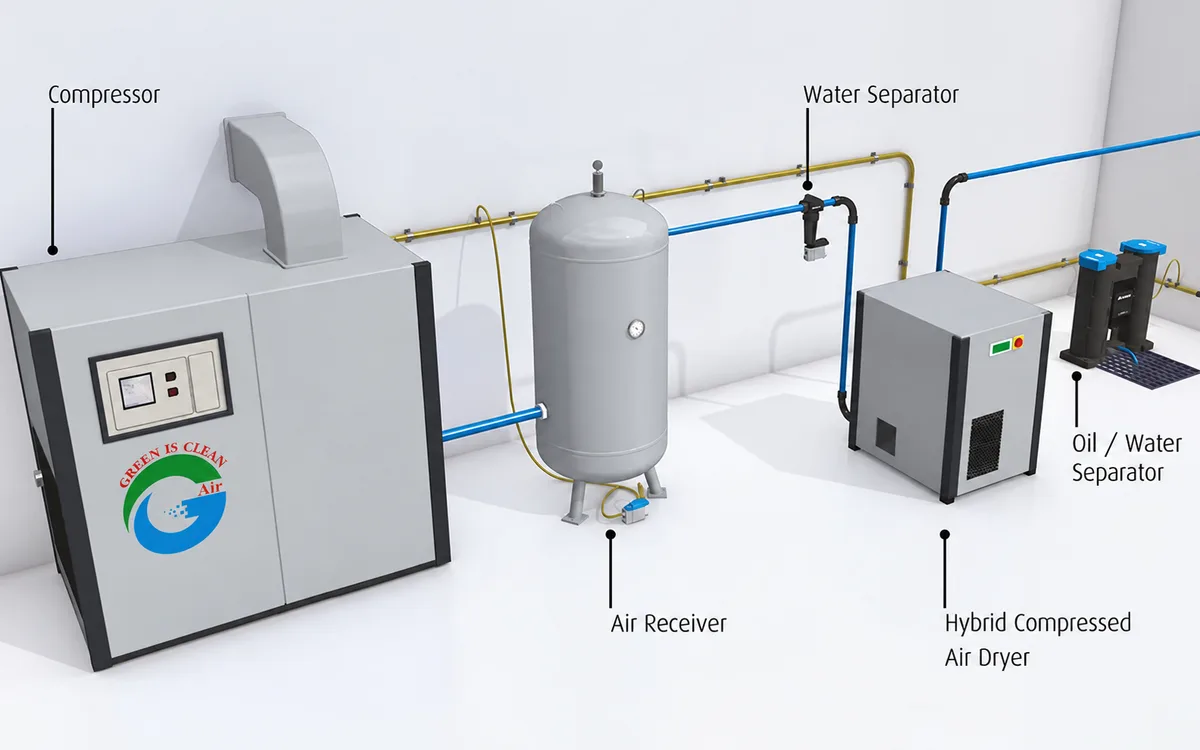
Overview
In an oil-injected screw compressor, oil is doing three jobs at once. It seals the small clearances between the rotors, which is what allows a comparatively cheap machine to compress efficiently. It absorbs the heat of compression, keeping discharge temperature around 80 – 90 °C instead of several hundred. And it lubricates the bearings.
Nearly all of that oil is separated out afterwards and recirculated. A good separator element leaves around 1 to 3 mg of oil per cubic metre of air, which is a very small amount but is not zero.
Whether that residual matters depends entirely on what you are doing with the air. In a fabrication shop, it is irrelevant. On a food filling line, it is the difference between a passed and a failed audit.
Key benefits
Lower purchase price
Typically 30 – 40% cheaper than an equivalent oil-free machine.
Efficient at part load
Oil sealing keeps the machine efficient across a wider operating range.
Simpler to service
Widely understood technology with straightforward, inexpensive consumables.
The oil has to be managed
Oily condensate needs a separator before discharge, and filtration is required if the air quality matters.
What the oil is doing
Three jobs at once. It seals the clearance between the rotors, it carries away the heat of compression, and it lubricates the bearings.
That is why an oil injected machine can run at eighty to ninety degrees rather than several hundred, and why it is smaller and cheaper than an oil free machine of the same output.
The separator then takes most of the oil back out, leaving one to three milligrams a cubic metre in the air, which is fine for almost everything except product contact.
- Seals the rotor clearance
- Carries away the heat of compression
- Lubricates the bearings
- Keeps discharge around 80 to 90 degrees
- Smaller and cheaper than oil free
- Separator removes most of it again
- One to three milligrams a cubic metre remains
- Filtration reduces it further where needed
Looking after it
Use the specification the machine was tested on and do not mix fluids. Mixing is the commonest cause of separator failure we are called to and it is entirely avoidable.
Change on interval and take a sample. What is in the oil tells you what the machine is living through long before anything shows on the panel.
Watch the separator pressure drop. A tired separator costs power every hour and gives no other sign that it is doing so.
- Correct specification, never mixed
- Changed on interval, not on appearance
- Sample taken at every change
- Separator watched on pressure drop
- Interval adjusted for ambient and dust
- Oil analysis included in our kits
- Used oil collected for disposal
- Food grade available where required
Frequently asked questions
What is the oil actually for?
Sealing the clearances between the rotors, absorbing the heat of compression, and lubricating the bearings, three jobs from one fluid.
How much oil ends up in the air?
A good separator element leaves 1–3 mg per cubic metre. Very small, but not zero, which is the whole basis of the oil-free argument.
Does that residual matter?
Entirely depends on the application. In a fabrication shop it is irrelevant. On a food filling line it is the difference between passing and failing an audit.
Why choose oil-injected at all?
It is typically 30–40% cheaper to buy, efficient across a wide operating range, and uses widely understood, inexpensive consumables.
What has to be managed because of the oil?
Oily condensate needs a separator before discharge, and filtration is required downstream if the air quality matters. Neither is difficult, but neither is optional.
Can filtration make it as good as oil-free?
On paper it gets close. The difference is what happens when a filter element fails or is not changed. With oil-free there is nothing to fail. That is a risk decision.
How often does the oil need changing?
Mineral 2,000 hours, semi-synthetic 4,000, full synthetic 8,000. In Gulf and Pakistani ambient temperatures synthetic is usually cheaper per hour.
What happens if I use the wrong oil?
It oxidises, forms varnish, blocks the separator and eventually damages the airend. Engine oil in a screw compressor is a genuinely expensive mistake.
How do I know the separator is worn?
Rising pressure drop across it, and more oil showing in the downstream filters. Both are measurable long before anything fails.
Is oil consumption normal?
A small amount, yes. Consumption climbing sharply usually means a failing separator, a return line problem or the machine running too hot.
Related products

Air compressor troubleshooting
The fault you can see, what usually causes it, and what to check before calling anyone.
Learn more
What an air compressor really costs
Why the purchase price is the small number, and what the other two are.
Learn more
What is compressed air?
Why it is called the fourth utility, and why it costs more than you think.
Learn more
How a rotary screw compressor works
Two rotors, one continuous flow, and why it replaced the piston machine.
Learn moreNot sure which model you need?
Send us your air demand, working pressure and running hours. Our engineers will size the machine and send a written recommendation, no cost, no obligation.