
What size air compressor do I need?
Flow first, pressure second and kilowatts last, with the arithmetic shown.
Start with air, not with kilowatts
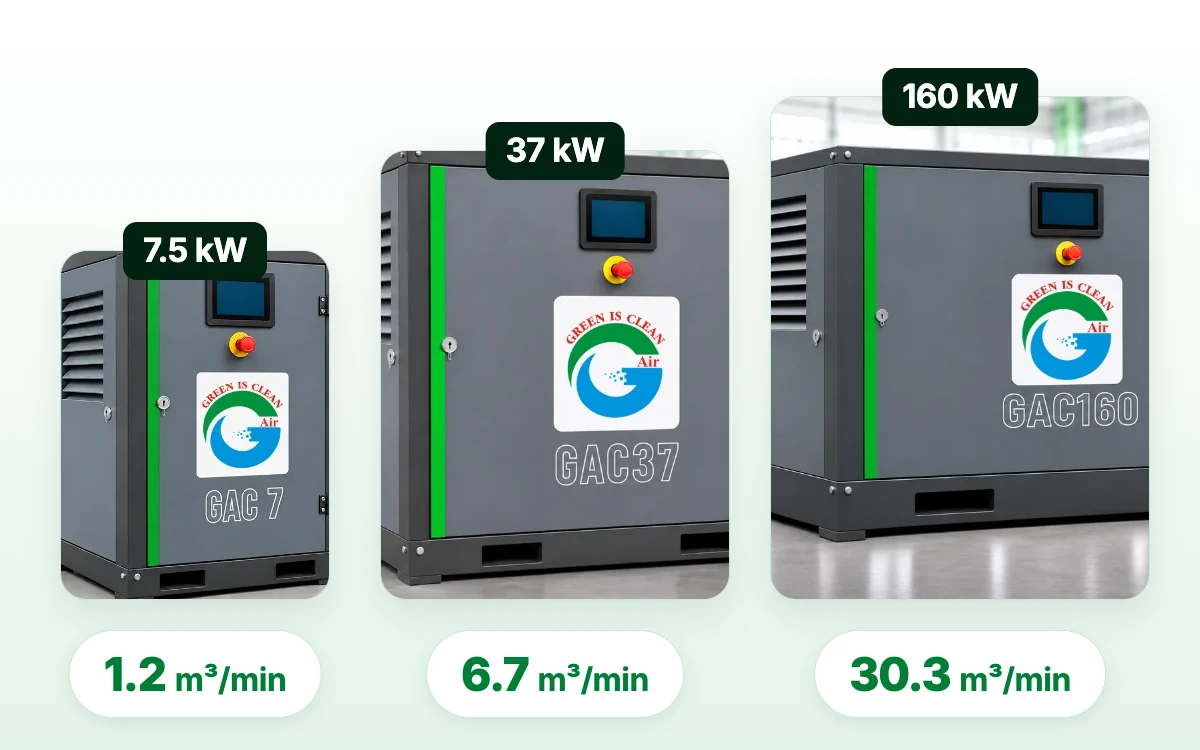
A compressor is bought to deliver a flow of air at a pressure. The kilowatts on the door are only what it takes to do that, which is why asking for a 37 kW compressor is asking for half of an answer. In our own range the same 37 kW motor delivers 6.70 m³/min at 8 bar and 4.88 m³/min at 13 bar.
So work in this order. Add up the air that is used at the same moment, not the air every machine could ever use. Add an allowance for leaks. Then choose the lowest pressure that does the work, because every bar above it costs about 7% of the electricity for as long as you own the machine.
If you already have a compressor, measure instead of adding. A week of logging shows the average, the peak and how long the peak really lasts, and it usually points to a smaller machine than the nameplates do.
The six things that decide it
Flow, in m³/min
List what runs at the same time. The figure on a tool's sheet is for a trigger held down, so multiply it by the share of the hour it is really held.
Pressure, where the work is done
Most tools and cylinders need about 6 bar at the point of use. That is about 7 bar at the compressor, after the dryer, the filters and the pipe have taken their share.
Leaks
A plant nobody has surveyed loses 20 to 30% of what it makes. Repair them before you size, then allow about 10% for the ones that come back.
Hours a day
Beyond about two hours a day a screw compressor is the right type, because it is rated to run without a rest. For a few short bursts a piston machine is enough.
The hottest day
Ask what the machine delivers, and whether it keeps running, at your own summer temperature. Our standard build is rated to 46 °C and a high ambient package takes it to 52 °C.
Growth
Allow for machines you have ordered, not for ones you might. A compressor that runs half loaded for years costs more than adding a second one when it is needed.
A worked example
A workshop has four air tools at 0.4 m³/min each, held about a quarter of the time. It has a blast cabinet at 1.2 m³/min that runs half of every hour, and a packing line that uses 0.6 m³/min all day.
The average is 0.4 for the tools, 0.6 for the cabinet and 0.6 for the line, which is 1.6 m³/min. The worst ordinary moment, with two tools and the cabinet working on top of the line, is 2.6 m³/min. With 10% for leaks that becomes about 2.9.
At 7 bar a screw compressor needs roughly 6 kW for every m³/min, so 2.9 points to about 17 kW and the next size up is 18.5 kW. Adding the nameplates would have given 3.4 m³/min, and a safety margin on top of that is how a workshop ends up with a 30 kW machine working a third of the time.
- Only what runs at the same moment
- Tool figures multiplied by trigger time
- Continuous users counted in full
- About 10% added for leaks
- About 6 kW per m³/min at 7 bar
- Next motor size up, not two sizes up
- Receiver covers the seconds above the peak
- A wide gap from average to peak favours variable speed
How a size goes wrong
The commonest mistake is a margin added at every step. The tool list carries one, the engineer adds another and the buyer rounds up. Three careful people together make a machine twice the size, and it spends its life unloaded, drawing a quarter to a third of full power and making no air.
The second is one process setting the pressure for everybody. If a single machine needs 10 bar and the rest of the factory needs 6, give that machine a booster or a compressor of its own rather than running the whole plant at 10.
The third is comparing different flows. Piston displacement is what the cylinder sweeps and free air delivery is what comes out. Only the second, measured to ISO 1217, can be added up.
- Margin added once, not three times
- One high pressure user kept separate
- Free air delivery, never displacement
- Pressure stated at the same point in every offer
- Summer temperature written in the enquiry
- Altitude stated above 1,000 metres
- Old machine logged before it is replaced
- Leaks repaired before the new one is sized
One machine or two
One compressor is cheaper to buy and leaves you with nothing on the day it stops. Two smaller ones cost more on the invoice and let you service one while the other carries the plant.
The usual arrangement where the plant cannot stop is a fixed speed machine for the base load and a variable speed machine that follows the rest. Together they are sized for the peak, and either one keeps the essential part going.
A machine that only stands by should still run every week. Compressors that sit for months fail on the day they are finally needed.
- One machine where a stop can wait a day
- Two where the plant cannot stop
- Fixed speed for the base, variable for the rest
- Lead and standby changed over by the controller
- Standby run every week
- Dryer and filters sized for what runs together
- Space and valves left for the second machine
- Rental considered for a short peak
Frequently asked questions
What size air compressor do I need for my workshop?
Add up the air your tools use while they are really running, take the most that run together and add about 10% for leaks. Three or four ordinary hand tools in use together usually come to 1 to 2 m³/min, which is about 7.5 to 15 kW.
How many kW do I need for 1 m³/min?
About 6 kW at 7 bar for a screw compressor, and roughly 7% more for every extra bar. So 5 m³/min at 7 bar is about 30 kW.
Is it better to buy a bigger compressor to be safe?
No. An oversized fixed speed machine runs unloaded, and unloaded it draws a quarter to a third of its full power and makes nothing. If you expect to grow, leave the space and the connections for a second machine.
What is cfm, and how do I convert it?
Cubic feet per minute. 1 m³/min is 35.3 cfm, so 100 cfm is about 2.8 m³/min.
What pressure should I ask for?
The pressure at the point of use plus about 1 bar for the dryer, the filters and the pipework. For most factories that is 7 to 8 bar. Every bar above what you need costs about 7% more electricity.
How do I measure the air I use now?
With a logger on the compressor you have. A week of load and unload times, or of power, gives the flow through the day. A flow meter in the main gives the same answer directly.
How much should I add for leaks?
About 10% after a survey and repair. Without a survey the real figure is commonly 20 to 30%, and it is cheaper to repair that than to buy a compressor for it.
Does hot weather change the size?
Yes. Hot air is thinner, so the same volume carries less of it, and the motor and the cooler work harder. Ask for the flow at your own summer temperature and for the temperature at which the machine trips.
Does altitude matter?
Air thins by roughly 1% for every 100 metres, so a machine on a high site delivers less, and its motor may need derating. Tell us the altitude when it is above 1,000 metres.
Can you size it for me?
Yes. Send us the list of users, the pressure, the working hours and your summer temperature. On an existing plant we prefer to log the old machine for a week first.
More guides
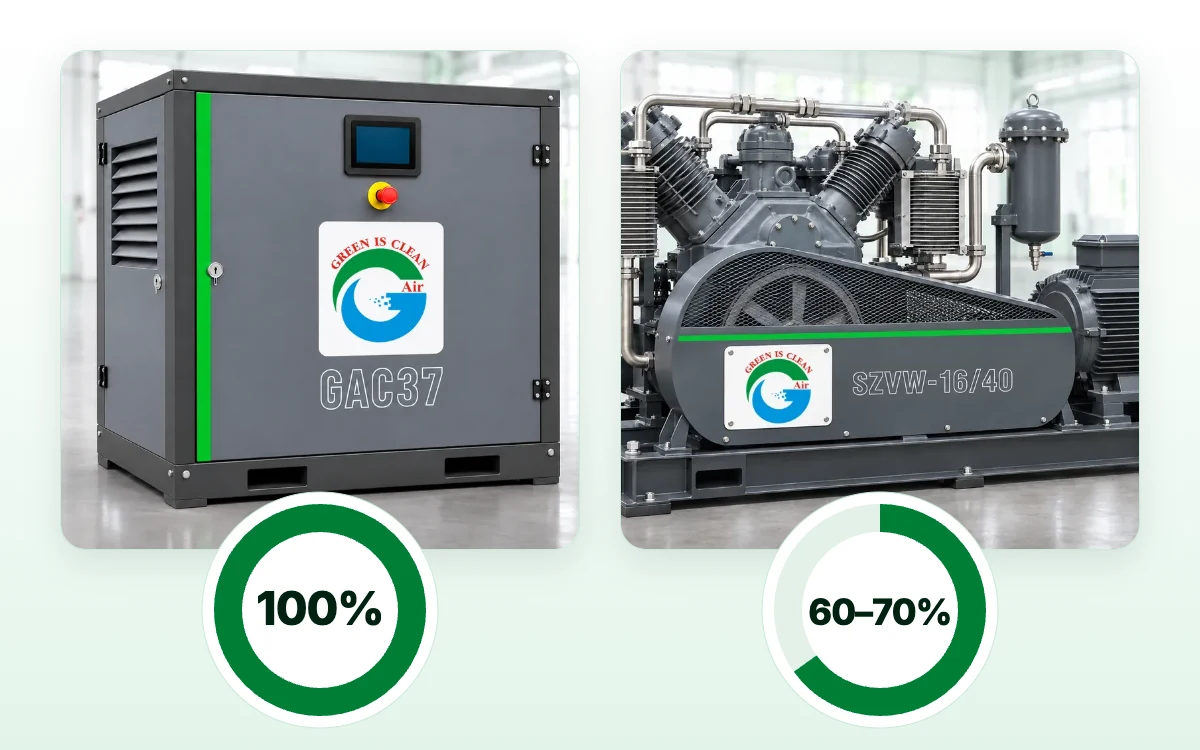
Screw or piston compressor?
How long it runs each day decides it, and here is where the line falls.
Learn more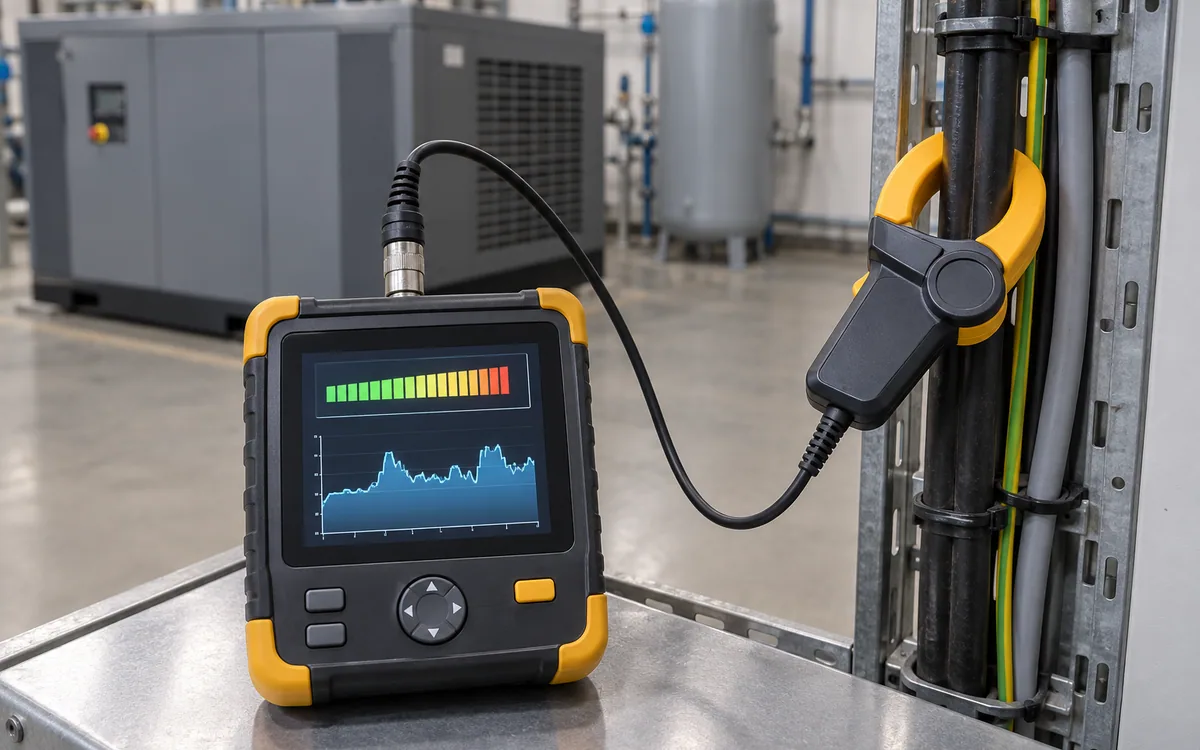
What an air compressor really costs
Why the purchase price is the small number, and what the other two are.
Learn more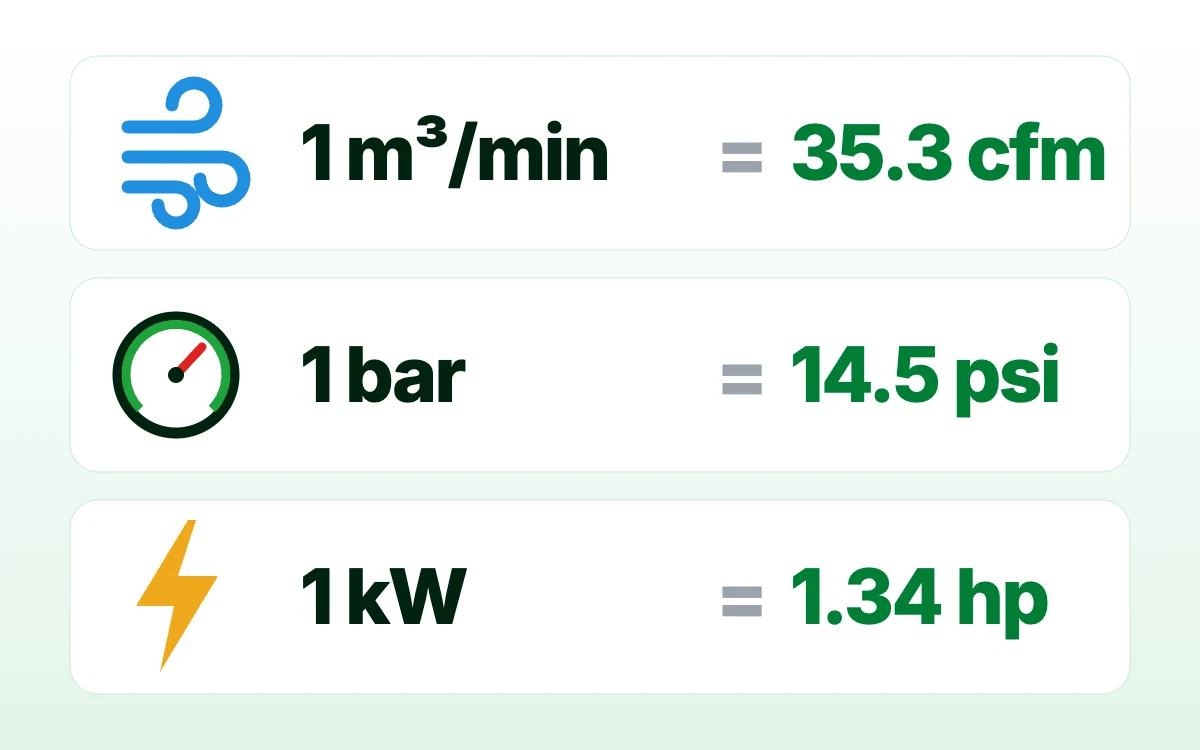
Bar, cfm, FAD and kW: the units on a quotation
What each unit means, how to convert it, and which ones hide the answer.
Learn more
Which air dryer do I need?
Dew point in plain words, and the one temperature that decides the type.
Learn moreNot sure which model you need?
Send us your air demand, working pressure and running hours. Our engineers will size the machine and send a written recommendation, no cost, no obligation.