概述
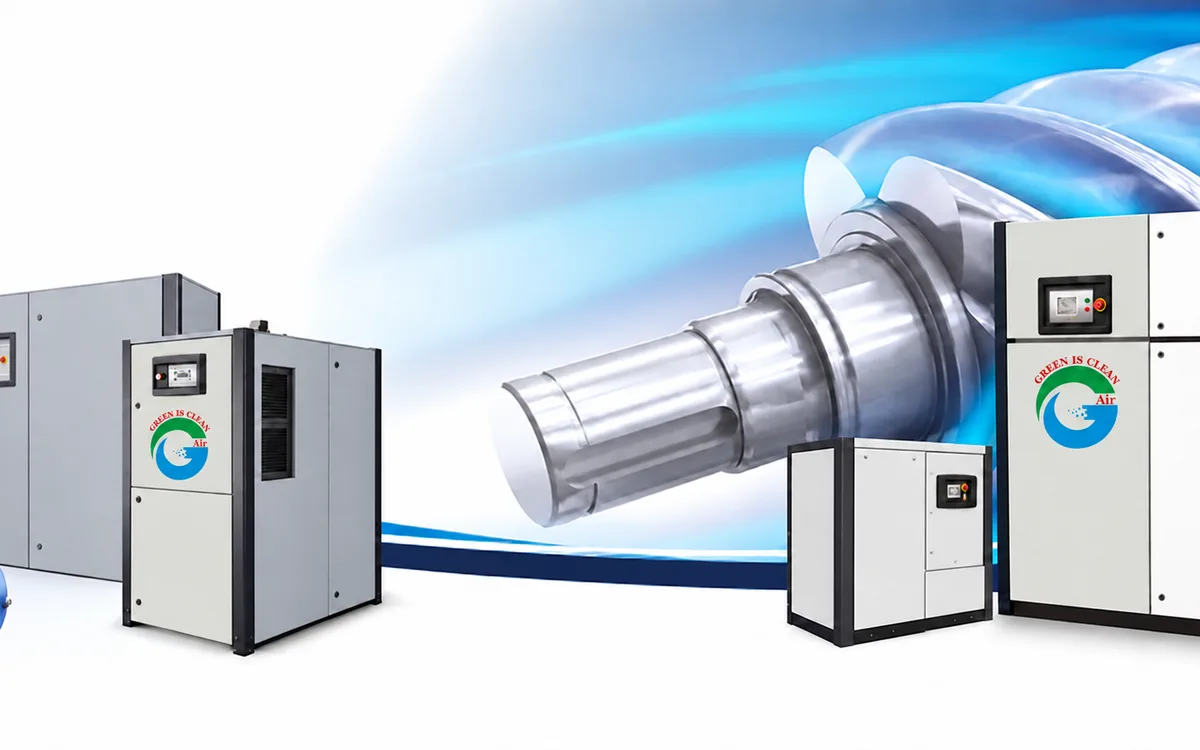
Inside a screw compressor are two helical rotors that mesh together, one with lobes and one with flutes. Air is drawn in at one end, trapped in the space between the rotors and the housing, and squeezed into a progressively smaller volume as it travels along towards the discharge port.
That is the whole idea. Because the process is continuous rather than reciprocating, there is no pulsation, very little vibration and no reason the machine cannot run indefinitely. A piston compressor, by contrast, is a series of impacts and needs rest periods to survive.
In an oil-injected machine, oil is sprayed into the compression chamber to seal the gap between the rotors, carry away heat and lubricate the bearings. It is then separated out afterwards and recirculated. In an oil-free machine, the rotors are timed by gears so they never touch, and nothing is injected at all.
主要优势
Continuous duty
No reciprocating parts, so 100% duty cycle is normal rather than exceptional.
Smooth output
No pulsation, which matters for instrumentation and for pipework fatigue.
Compact for its output
Considerably smaller and lighter than a piston machine of the same capacity.
Long service life
20,000 to 40,000 hours before an airend overhaul is normal with correct maintenance.
Why it is the usual choice
Compression is continuous rather than in strokes, so there is no pulsation in the delivery and no duty cycle to respect. It is rated to run all day.
It is compact for its output and it runs quietly enough to stand on a shop floor rather than needing a compressor house.
And it lasts. Forty to sixty thousand hours before a major overhaul is normal on a maintained machine, which is fifteen years at one shift.
- 连续压缩,没有脉动
- 按百分之百负载率设计
- Compact and quiet for its output
- 大修前可运行 40,000 至 60,000 小时
- Oil injected or oil free
- 工频或变频
- 单级或双级
- 风冷或水冷
What decides how long it lasts
Oil, first and last. The right specification, changed on interval, and never mixed with another. Mixing fluids is the commonest cause of separator failure we attend.
Then temperature. A machine breathing its own hot exhaust runs at the top of its range all day and everything in it ages faster.
Then air quality going in. Dust reaching the airend is what turns a fifteen year machine into a seven year one.
- Correct oil, on interval, never mixed
- Intake air cool rather than recirculated
- Intake filtration matched to the site
- Cooler kept clean
- Separator changed on pressure drop
- Ventilation sized for the heat rejected
- Oil analysis to catch problems early
- Serviced to a schedule that suits the site
常见问题
What is actually happening inside?
Two helical rotors mesh and trap air between themselves and the housing. As the air travels along the rotors that space shrinks, so it is squeezed continuously rather than in pulses.
Why is there no pulsation?
Because compression is continuous rather than reciprocating. That means almost no vibration, which is why these machines can sit on a shop floor without a special foundation.
What is the oil doing in an oil-injected machine?
Three jobs at once: sealing the clearance between the rotors, absorbing the heat of compression, and lubricating the bearings. Most of it is separated out and recirculated.
How does an oil-free machine seal without it?
It does not seal with a fluid at all. The rotors are made to far tighter tolerances, coated, and timed by precision gears so they never touch.
Why can it run at 100% duty?
No reciprocating mass means no impact loading and no need to shed heat between strokes. Continuous running is what the design is for.
What limits airend life?
Bearings and rotor clearances, both driven by oil condition and intake cleanliness. Hours matter far less than how clean and cool the machine has been kept.
How does the machine control output?
Fixed-speed machines load and unload against a pressure band. Variable-speed machines change rotor speed to match demand, which removes the unloaded running entirely.
Where does all the heat go?
Into the oil and then into the cooler, which is why the plant room needs ventilation. It is also why heat recovery works so well on these machines.
What is the separator for?
It takes the oil back out of the compressed air after compression. A worn separator raises oil carry-over and pressure drop at the same time.
Why is it the industry standard?
Continuous duty, compact size, low vibration and long service life. Between roughly 5 and 250 kW very little else competes.