
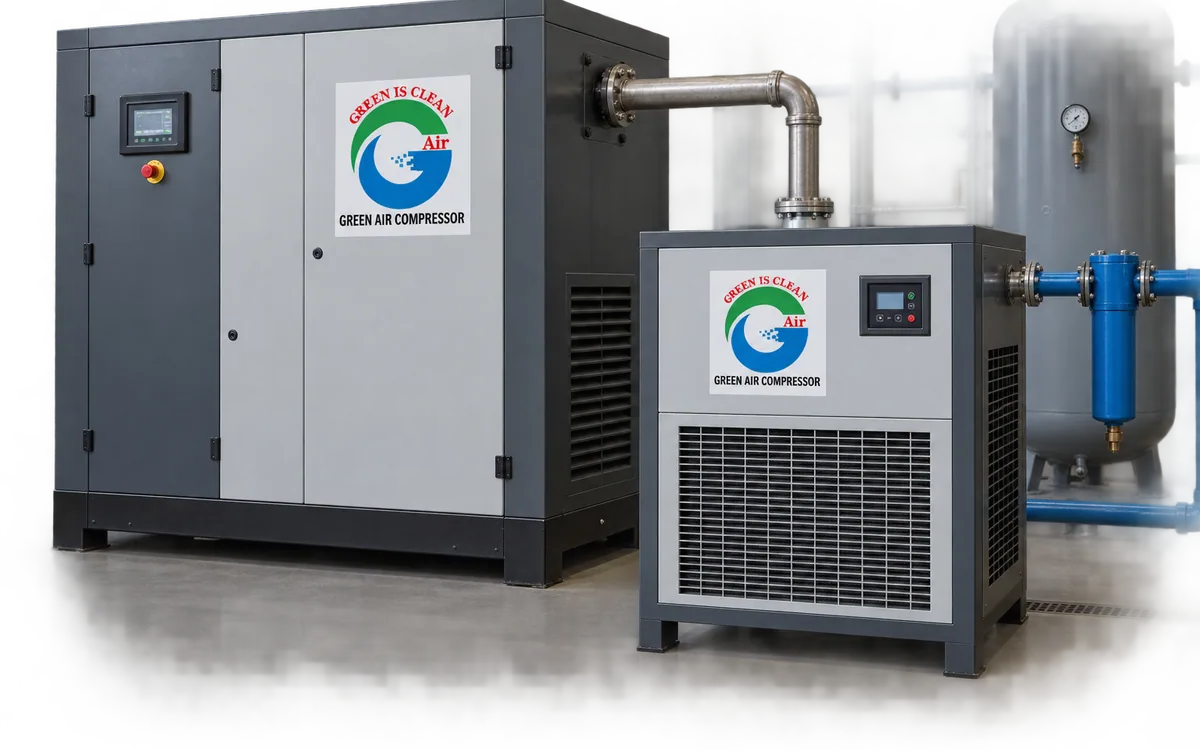
高温型冷冻式干燥机
可直接接收压缩机出口最高 80 °C 的空气,无需前置冷却器。
技术参数
- 容积流量(FAD)
- 1.2 – 65.0 m³/min
- 电机功率
- 8 – 355 kW
概述
A standard refrigerant dryer expects air at around 35 to 45 °C. Air coming straight off a compressor without an aftercooler can be 70 or 80 °C, and feeding that to a standard dryer either trips it or ruins it.
The usual fix is an aftercooler, and where there is room for one that is the right answer. Where there is not — a retrofit, a tight skid, a machine whose aftercooler has been outgrown — a high temperature dryer handles the inlet directly.
主要优势
Up to 80 °C inlet
Takes the air as the compressor delivers it, with no separate aftercooler in the line.
Saves a component and its space
One item instead of two, which on a retrofit into an existing plant room is often the deciding factor.
Built for the heat
Oversized condenser and a heat exchanger designed for the duty rather than a standard one pushed past its rating.
Standard 3 °C dew point
Same outlet performance as an ordinary refrigerant dryer. The difference is what it will accept at the inlet.
When to use one
On a retrofit where there is no room for an aftercooler, or where the existing aftercooler has been outgrown because the compressor was replaced with a larger one and the cooler was not.
On a skid or a container where every component has to justify its footprint. One high temperature dryer occupies less than an aftercooler plus a standard dryer.
Where ambient conditions make an air cooled aftercooler ineffective. In a plant room that is already at 45 °C, an air cooled aftercooler has very little temperature difference to work with and the dryer downstream sees hot air regardless.
- Retrofits with no space for an aftercooler
- Skids and containerised stations
- Hot plant rooms where aftercooling is ineffective
- Compressor upgraded, aftercooler not
- 3 °C pressure dew point at outlet
- Cyclone separator still required upstream
机型范围
- 容积流量(FAD)
- 1.2 m³/min
- 接口
- G3/4 in
- 容积流量(FAD)
- 1.6 m³/min
- 接口
- G3/4 in
- 容积流量(FAD)
- 2.6 m³/min
- 接口
- G1 in
- 容积流量(FAD)
- 3.8 m³/min
- 接口
- G1-1/2 in
- 容积流量(FAD)
- 6.5 m³/min
- 接口
- G1-1/2 in
- 容积流量(FAD)
- 8.5 m³/min
- 接口
- G2 in
- 容积流量(FAD)
- 11.5 m³/min
- 接口
- G2 in
- 容积流量(FAD)
- 13.5 m³/min
- 接口
- G2 in
- 容积流量(FAD)
- 18.5 m³/min
- 接口
- G2-1/2 in
- 容积流量(FAD)
- 20.5 m³/min
- 接口
- G3 in
- 容积流量(FAD)
- 25 m³/min
- 接口
- G3 in
- 容积流量(FAD)
- 35 m³/min
- 接口
- G4 in
- 容积流量(FAD)
- 45 m³/min
- 接口
- DN100
- 容积流量(FAD)
- 55 m³/min
- 接口
- DN125
- 容积流量(FAD)
- 65 m³/min
- 接口
- DN125
性能按 ISO 1217 附录 C,进气 20 °C、1 bar(a)。数据为典型值,以最终确认为准。可向我们索取所选机型的检测报告。
常见问题
Is it less efficient than a standard dryer plus aftercooler?
Slightly, on energy. It wins on space, on capital cost and on having one fewer item to install and maintain.
Do I still need a water separator?
Yes. A great deal of water drops out as that air cools, and it has to go somewhere other than into the dryer's heat exchanger.
What dew point does it give?
Around 3 °C, the same as a standard refrigerant dryer. Where you need lower than that you need a desiccant dryer regardless of the inlet temperature.
What inlet temperature can it take?
Up to 80 °C, which covers air taken straight off a compressor with no aftercooler in the line.
When is it the right choice?
Retrofits with no room for an aftercooler, skids and containers where space is scarce, and hot plant rooms where air cooling an aftercooler achieves little.
Why is the condenser oversized?
Because it is rejecting the heat that an aftercooler would otherwise have removed. A standard dryer pushed to this duty would trip on high pressure.
Can it handle a hot plant room too?
Ambient rating is separate from inlet rating and both are stated. In a plant room already at 45 °C we check the two together rather than assuming.
Does it need more maintenance?
The condenser needs keeping clean, and in a dusty plant room that is the item most often neglected. Otherwise the schedule is the same as any refrigerant dryer.
Will it cope if the compressor is upgraded?
Only within its rated flow. A dryer sized for the old machine is the commonest cause of wet air after a compressor is replaced.
Is the drain included?
Yes, and there is a lot of condensate at this inlet temperature. An automatic drain is specified with it rather than left to site.
相关产品
不确定该选哪个型号?
把您的用气量、工作压力和运行小时数发给我们。我们的工程师会完成选型并给出书面建议,不收费,也不构成任何义务。