
Centrifugal compressors
Very high flow, oil-free air for large continuous processes.
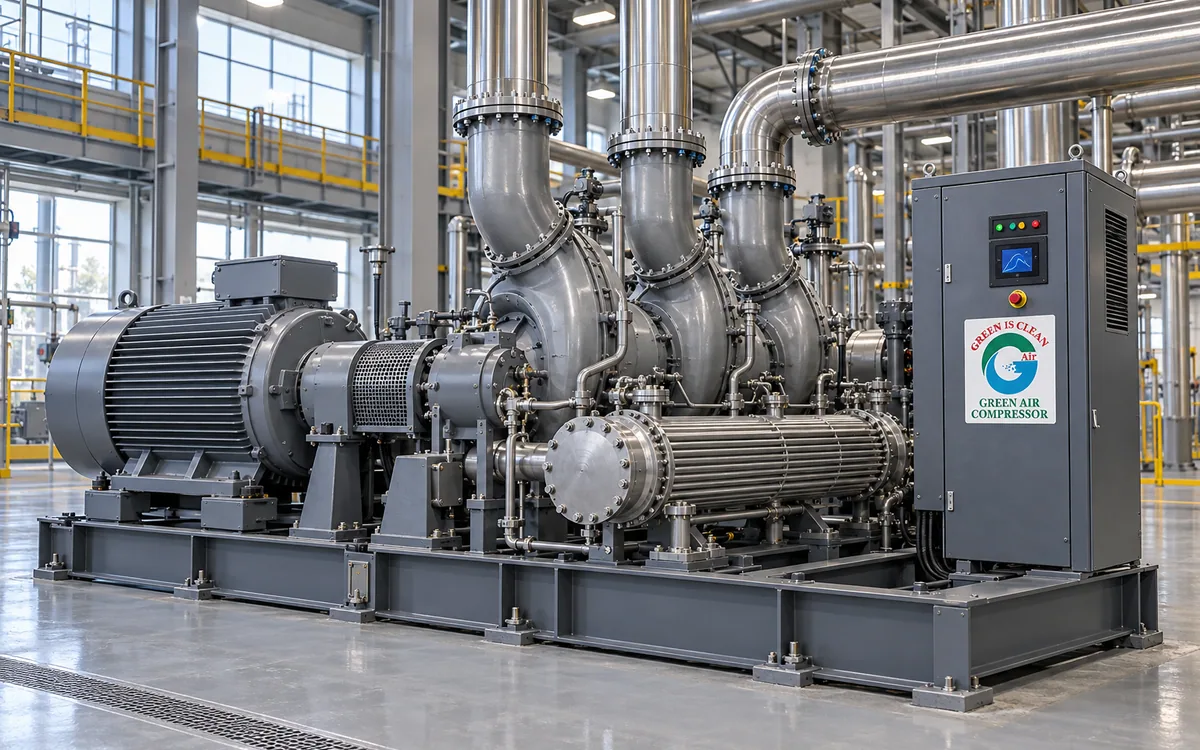
Overview
Above roughly 300 kW of continuous duty, a centrifugal machine is usually the most efficient option. It accelerates air with a high-speed impeller instead of trapping it between rotors, and it delivers oil-free air by design because there is no oil in the compression path.
These are engineered machines, selected around your specific flow, pressure, cooling water and ambient conditions rather than picked from a list.
Key benefits
Very high flow
Single machines covering flows well beyond the practical limit of screw compressors.
Oil-free by design
No lubricant in the air path at all, Class 0 without filtration.
Low maintenance
Few wearing parts in the gas path. Long intervals between major overhauls.
Engineered selection
Performance curve matched to your duty point, including summer and winter conditions.
How it is built
An impeller spinning at high speed accelerates the gas, and a diffuser turns that speed into pressure. There is no contact and no oil in the gas path, so the air is clean without filtration.
These are continuous duty machines. They suit a large, steady demand, and they are not the right answer where the load swings about, which is the most important thing to know before buying one.
Multiple stages with intercooling between them are how the pressure is reached efficiently. The intercoolers are as much a part of the machine as the impellers.
- Oil free gas path by design
- Multiple stages with intercooling
- Built for large continuous demand
- Not suited to widely swinging loads
- Very high efficiency at the design point
- Long intervals between overhauls
- Water cooled as standard
- Certified performance to ISO 1217
What the controller does
Capacity is followed with inlet guide vanes first and blow off only as a last resort, because blow off is compressed air thrown away.
Surge protection is not optional on this design. The control keeps the machine away from the surge line at every operating point rather than leaving it to the operator.
Flow, pressure, power and specific energy are all shown, and specific energy is the number that says whether the machine is still worth what it cost.
- Inlet guide vane control
- Blow off used only as a last resort
- Surge protection at every operating point
- Specific energy shown on screen
- Sequencing with other machines
- Vibration monitored continuously
- Remote monitoring as standard
- Full trending and fault history
Parts and service
Bearings, seals and the gearbox on published intervals, with vibration and performance recorded at every visit.
A centrifugal machine gives a great deal of warning through vibration and through efficiency, and both are only useful if somebody is recording them.
Overhauls are planned rather than reactive. On a machine of this size an unplanned stop costs far more than the overhaul does.
- Bearing and seal service by interval
- Gearbox inspection on the schedule
- Vibration recorded at every visit
- Specific energy tracked against commissioning
- Overhauls planned, not reactive
- Site spares list agreed at commissioning
- Cooler cleaning included
- Fixed price under a service plan
Frequently asked questions
How does a centrifugal compressor work?
An impeller accelerates the gas and a diffuser converts that velocity into pressure. It is dynamic compression, not positive displacement.
When is it the right machine?
At high flow, usually above 100 m³/min. Below that a screw machine is normally more efficient and much simpler to operate.
Is the air oil-free?
Yes, in the compression path. There is no lubricant in the gas stream, which is why these machines suit large food, pharmaceutical and electronics plants.
What is surge?
Flow reversal when demand drops too far. It is noisy, damaging and must be prevented by control: never treated as an operating condition.
How is capacity controlled?
Inlet guide vanes, and blow-off as a last resort. Guide vanes are efficient over a wide range. Blow-off is compressed air thrown away.
How long does the machine last?
Decades. There is no rubbing contact in the gas path, so with clean gas and good bearings these are extremely long-lived machines.
What maintenance does it need?
Bearing and gearbox oil, condition monitoring, and periodic inspection. Vibration analysis matters far more on these than on a screw compressor.
Is the efficiency better?
At full load and high flow, yes. Efficiency falls faster off design point, so the sizing has to match the real duty rather than a hoped-for future one.
What about heat recovery?
Excellent, large, concentrated heat at a useful temperature. On a big plant this is often the largest single recovery opportunity available.
What does installation involve?
A designed foundation, cooling water or air, and a proper control interface. These are project installations, not a delivery and a plug.
Related products
Not sure which model you need?
Send us your air demand, working pressure and running hours. Our engineers will size the machine and send a written recommendation, no cost, no obligation.