
Air receivers and storage tanks
0.3 to 10 m³, carbon steel, stainless and vacuum. 8, 10 and 13 bar g.
Technical data
- Working pressure
- 1 – 13 bar g
- Weight
- 99 – 1,240 kg
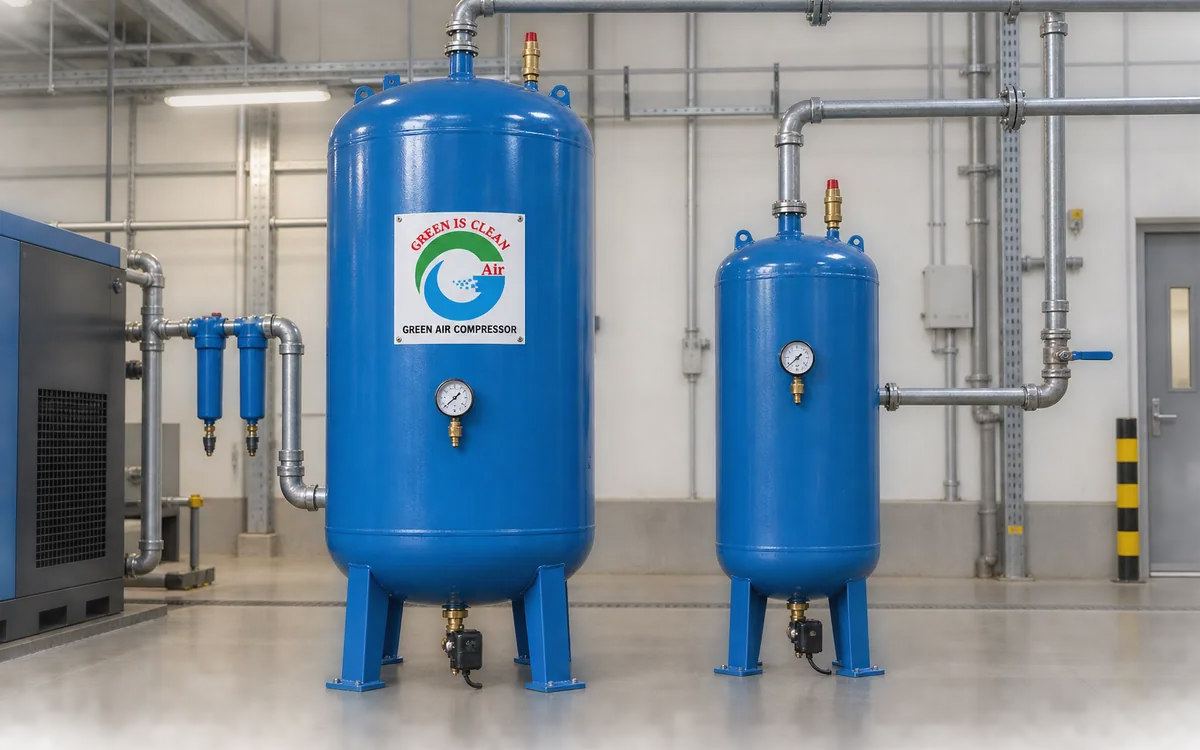
Overview
A receiver does three jobs that nothing else in the system does. It stores air so the compressor is not chasing every short peak, it lets water and oil drop out before they reach the ring main, and it damps the pressure swings that make a small compressor start and stop dozens of times an hour.
It is also the cheapest component in the system and the one most often undersized. A receiver that is half the size it should be will make a good compressor look like a bad one, and the symptom — a machine that short cycles and runs hot — is usually blamed on the compressor.
Key benefits
Fewer starts, longer motor life
Starting is what kills contactors and motors. Correct storage turns forty starts an hour into six.
Water drops out here
Air slows down inside the vessel and moisture separates. That is work the dryer then does not have to do.
Covers the peaks
A short heavy demand is met from storage instead of from a bigger compressor that idles the rest of the day.
Carbon steel, stainless or vacuum
Q235-B and Q345R for general duty, S30408 stainless where the air touches product, and negative pressure vessels for vacuum systems.
How big it should be
The usual rule for a fixed speed machine is somewhere between six and ten litres of storage for every litre per second the compressor delivers — so a machine giving 50 l/s wants between 300 and 500 litres as a minimum, and more if the demand is peaky.
The real test is starts per hour. Most motors in this class are happy with six to ten starts an hour and unhappy above about twenty. If your machine is cycling more than that, the receiver is too small and adding one is cheaper than anything else you could do.
A variable speed machine needs less storage for cycling, because it does not cycle, but it still needs storage for peaks and for separation. The common mistake is assuming a VSD means no receiver.
Where the demand has a large short peak — a big blow off, a cleaning cycle, a burst of tools — a separate receiver close to that demand is worth more than the same volume back at the compressor.
- Six to ten litres per litre per second, as a starting point
- Under ten starts an hour on a fixed speed machine
- Storage still needed on a variable speed machine
- A local receiver for a local peak
- Drain fitted and piped, always
- Safety valve and gauge as supplied
Inspection and the paperwork
A receiver is a pressure vessel and in every country we trade in it is subject to periodic inspection. Which authority, at what interval and to what standard varies, and we will tell you what applies where the vessel is going.
Vessels are supplied with their material certificates and their test records. Keeping those together with the machine matters more than people expect — an inspector who cannot see the documents will often fail a vessel that is perfectly sound.
Material matters for the same reason. Q235-B covers general duty, Q345R is used where the pressure or the size demands it, and S30408 stainless is specified where the air is in contact with food, pharmaceutical or medical processes. The table below states which material each build uses rather than leaving it to be asked.
Model range
Carbon steel, general duty
- 8 bar g
- —
- Connection
- RP 1 1/2 / DN 50
- Dimensions L x W x H
- 550 mm dia × 1589 mm
- 10 bar g
- —
- Connection
- RP 1 1/2 / DN 50
- Dimensions L x W x H
- 550 mm dia × 1589 mm
- 13 bar g
- —
- Connection
- RP 1 1/2 / DN 50
- Dimensions L x W x H
- 550 mm dia × 1593 mm
- 8 bar g
- —
- Connection
- RP 1 1/2 / DN 50
- Dimensions L x W x H
- 700 mm dia × 1900 mm
- 10 bar g
- —
- Connection
- RP 1 1/2 / DN 50
- Dimensions L x W x H
- 700 mm dia × 1902 mm
- 13 bar g
- —
- Connection
- RP 1 1/2 / DN 50
- Dimensions L x W x H
- 650 mm dia × 2068 mm
- 8 bar g
- —
- Connection
- RP 2 / DN 65
- Dimensions L x W x H
- 800 mm dia × 2205 mm
- 10 bar g
- —
- Connection
- RP 2 / DN 65
- Dimensions L x W x H
- 800 mm dia × 2207 mm
- 13 bar g
- —
- Connection
- RP 2 / DN 65
- Dimensions L x W x H
- 800 mm dia × 2205 mm
- 8 bar g
- —
- Connection
- RP 2 / DN 65
- Dimensions L x W x H
- 1000 mm dia × 2265 mm
- 10 bar g
- —
- Connection
- RP 2 / DN 65
- Dimensions L x W x H
- 1000 mm dia × 2265 mm
- 13 bar g
- —
- Connection
- RP 2 / DN 65
- Dimensions L x W x H
- 1000 mm dia × 2817 mm
- 8 bar g
- —
- Connection
- RP 2 / DN 80
- Dimensions L x W x H
- 1000 mm dia × 2780 mm
- 10 bar g
- —
- Connection
- RP 2 / DN 80
- Dimensions L x W x H
- 1000 mm dia × 2780 mm
- 13 bar g
- —
- Connection
- RP 2 / DN 80
- Dimensions L x W x H
- 1000 mm dia × 2782 mm
- 8 bar g
- —
- Connection
- DN 80
- Dimensions L x W x H
- 1000 mm dia × 3300 mm
- 10 bar g
- —
- Connection
- DN 80
- Dimensions L x W x H
- 1000 mm dia × 3300 mm
- 13 bar g
- —
- Connection
- DN 80
- Dimensions L x W x H
- 1000 mm dia × 3302 mm
- 8 bar g
- —
- Connection
- DN 80
- Dimensions L x W x H
- 1200 mm dia × 2880 mm
- 10 bar g
- —
- Connection
- DN 80
- Dimensions L x W x H
- 1200 mm dia × 2882 mm
- 13 bar g
- —
- Connection
- DN 80
- Dimensions L x W x H
- 1200 mm dia × 2372 mm
- 8 bar g
- —
- Connection
- DN 100
- Dimensions L x W x H
- 1400 mm dia × 3030 mm
- 10 bar g
- —
- Connection
- DN 100
- Dimensions L x W x H
- 1400 mm dia × 3032 mm
- 13 bar g
- —
- Connection
- DN 100
- Dimensions L x W x H
- 1400 mm dia × 3036 mm
- 8 bar g
- —
- Connection
- DN 100
- Dimensions L x W x H
- 1400 mm dia × 3630 mm
- 10 bar g
- —
- Connection
- DN 100
- Dimensions L x W x H
- 1400 mm dia × 3632 mm
- 13 bar g
- —
- Connection
- DN 100
- Dimensions L x W x H
- 1400 mm dia × 3636 mm
- 8 bar g
- —
- Connection
- DN 100
- Dimensions L x W x H
- 1400 mm dia × 4230 mm
- 10 bar g
- —
- Connection
- DN 100
- Dimensions L x W x H
- 1400 mm dia × 4232 mm
- 13 bar g
- —
- Connection
- DN 100
- Dimensions L x W x H
- 1400 mm dia × 4236 mm
Vacuum receivers, negative pressure
- -1 bar g
- —
- Connection
- RP 1 1/2
- Weight
- 99 kg
- Dimensions L x W x H
- 550 mm dia × 1569 mm
- -1 bar g
- —
- Connection
- RP 1 1/2
- Weight
- 167 kg
- Dimensions L x W x H
- 600 mm dia × 2035 mm
- -1 bar g
- —
- Connection
- RP 1 1/2
- Weight
- 167 kg
- Dimensions L x W x H
- 700 mm dia × 1880 mm
- -1 bar g
- —
- Connection
- RP 1 1/2
- Weight
- 263 kg
- Dimensions L x W x H
- 800 mm dia × 2180 mm
- -1 bar g
- —
- Connection
- RP 2
- Weight
- 367 kg
- Dimensions L x W x H
- 900 mm dia × 2502 mm
- -1 bar g
- —
- Connection
- RP 2
- Weight
- 527 kg
- Dimensions L x W x H
- 1000 mm dia × 2754 mm
- -1 bar g
- —
- Connection
- RP 2
- Weight
- 643 kg
- Dimensions L x W x H
- 1000 mm dia × 3254 mm
- -1 bar g
- —
- Connection
- DN 65
- Weight
- 679 kg
- Dimensions L x W x H
- 1200 mm dia × 2854 mm
- -1 bar g
- —
- Connection
- DN 65
- Weight
- 913 kg
- Dimensions L x W x H
- 1400 mm dia × 3006 mm
- -1 bar g
- —
- Connection
- DN 65
- Weight
- 1,076 kg
- Dimensions L x W x H
- 1400 mm dia × 3606 mm
- -1 bar g
- —
- Connection
- DN 65
- Weight
- 1,240 kg
- Dimensions L x W x H
- 1400 mm dia × 4206 mm
FAD measured to ISO 1217 Edition 4, Annex C and E at 1 bar a intake, 20°C, 0% humidity. Noise measured to ISO 2151 in free field conditions, tolerance ± 3 dB(A). Water-cooled versions of every model are available. Ask us for their sheet.
Frequently asked questions
What size receiver do I need?
Start at six to ten litres for every litre per second the compressor delivers, then check starts per hour. Over about ten starts an hour it needs more.
Do I still need one with a variable speed compressor?
Yes. A VSD removes the cycling problem, not the peak demand or the separation. Sizing is smaller, not zero.
Does it need inspecting?
Yes, it is a pressure vessel. The interval and the authority differ by country and we tell you which applies to yours before it ships.
What do the material codes mean?
Q235-B and Q345R are carbon steel grades for general duty; S30408 is stainless for product contact air. The table states which each build uses.
What pressure ratings are available?
8, 10 and 13 bar g on the carbon steel and stainless ranges, plus negative pressure vessels for vacuum systems.
Why do I need an automatic drain?
Because a receiver that fills with water stops separating and starts sending it downstream. A manual drain is one that someone eventually stops opening.
Can it be installed outdoors?
Yes, with appropriate protection and drainage. In a cold climate the drain needs trace heating so it does not freeze shut.
How is it connected?
The connection size is stated for each build in the table. Undersizing the connection throttles the vessel and defeats much of the point of having it.
What documentation comes with it?
Material certificates and test records. Keeping them with the vessel matters, because an inspector who cannot see the papers will often fail a sound tank.
Should the receiver go before or after the dryer?
Usually before, so water drops out in the vessel rather than loading the dryer. A second receiver after the dryer adds storage for peaks of dry air.
Not sure which model you need?
Send us your air demand, working pressure and running hours. Our engineers will size the machine and send a written recommendation, no cost, no obligation.