
Variable speed liquid ring vacuum pumps
The same tolerance, with the energy waste taken out.
Technical data
- Working pressure
- 130 bar g
- Motor power
- 4 – 22 kW
- Weight
- 110 – 340 kg
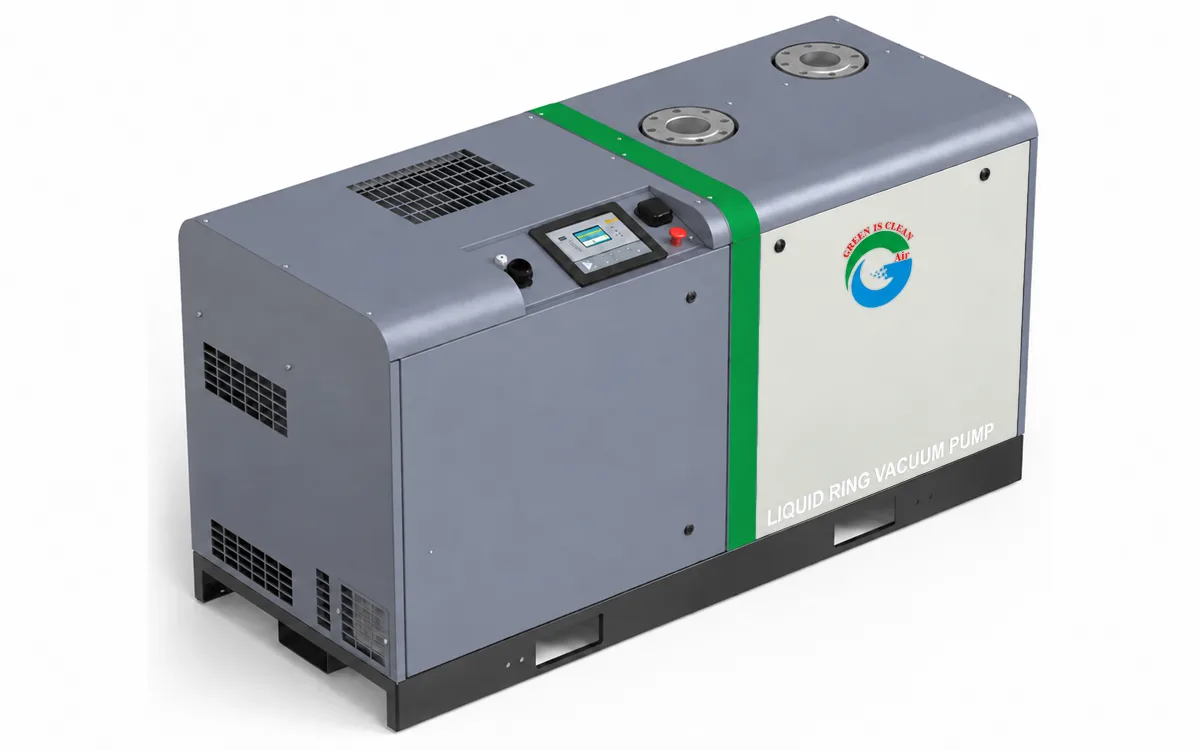
Overview
Liquid ring pumps have historically been run flat out and throttled, which is simple and wasteful. On a paper machine where the vacuum system can be several hundred kilowatts, that waste is a very large number.
Adding variable speed control lets the pump follow the actual vacuum demand. Sealing water consumption falls with it, which on sites paying for treated water is a second saving that often gets forgotten.
Key benefits
Typically 30 – 50% less energy
Compared with a fixed-speed pump throttled to the same duty.
Less sealing water
Water consumption falls with speed. On treated water that is a real cost saving.
Stable vacuum level
Closed-loop control holds the setpoint rather than hunting around it.
Retrofittable
Existing liquid ring installations can often be converted without replacing the pump.
How it is built
A ring of liquid spinning inside the housing does the sealing and the compressing. Because the pumping element is a liquid, the pump is almost indifferent to water, vapour, slugs and carry over that would stop a dry pump.
There is no dry rubbing contact and no oil in the gas path. The gas is cooled and washed by the liquid as it passes, which is why this design copes with things other pumps cannot be asked to handle.
Variable speed changes the economics. A liquid ring pump at fixed speed uses the same water and the same power all day, and at variable speed it uses what the process actually needs.
- Liquid ring seals and compresses
- Tolerant of water, vapour and slugs
- No dry contact and no oil in the gas path
- Gas cooled and washed in passing
- Variable speed cuts water and power
- Once through, partial or closed recovery
- Corrosion resistant materials available
- Continuous duty rated
Controls and monitoring
Vacuum level, motor load, seal liquid flow and seal liquid temperature. The last two are what a liquid ring pump lives on and they are the ones usually left unmonitored.
Variable speed follows the process, and the water saving usually turns out to be as large as the electricity saving. Both are shown on the screen.
Alarms on loss of seal liquid, high temperature and loss of vacuum. Loss of seal liquid is the one that damages the pump quickly.
- Seal liquid flow and temperature monitored
- Loss of seal liquid alarmed and interlocked
- Water and power saving both displayed
- Speed follows the process demand
- Vacuum level and motor load shown
- Service countdown in hours
- Volt free contacts for plant alarms
- Remote monitoring as standard
Parts and service
Filters, seals and the scheduled wear items, quoted against the serial number and the process. Two identical pumps on different duties do not take the same interval.
A vacuum pump rarely fails without warning. Ultimate pressure drifting, a longer pump down time and a rising temperature all appear first, which is why those three are measured at every visit.
We test after service rather than simply finishing. The pump down curve and the ultimate pressure achieved go on the report, so you know what you have rather than what was intended.
- Filter and seal kits by interval
- Intervals set by the process, not the calendar
- Ultimate pressure tested after every service
- Pump down curve recorded
- Confirmed against your serial number
- Held in local stock
- Workshop overhaul where testing is needed
- Fixed price under a service plan
Model range
- 130 mbar
- 97 m³/h
- Weight
- 110 kg
- Dimensions L x W x H
- 811 x 330 x 329 mm
- 130 mbar
- 180 m³/h
- Weight
- 122 kg
- Dimensions L x W x H
- 879 x 330 x 351 mm
- 130 mbar
- 267 m³/h
- Weight
- 157 kg
- Dimensions L x W x H
- 988 x 330 x 380 mm
- 130 mbar
- 551 m³/h
- Weight
- 317 kg
- Dimensions L x W x H
- 1297 x 396 x 478 mm
- 130 mbar
- 867 m³/h
- Weight
- 340 kg
- Dimensions L x W x H
- 1457 x 425 x 506 mm
FAD measured to ISO 1217 Edition 4, Annex C and E at 1 bar a intake, 20°C, 0% humidity. Noise measured to ISO 2151 in free field conditions, tolerance ± 3 dB(A). Water-cooled versions of every model are available. Ask us for their sheet.
Frequently asked questions
What does variable speed add to a liquid ring pump?
It lets the pump match the actual demand instead of running flat out and controlling with a bleed valve, which is pure waste.
How much energy does it save?
Typically 30–50% on varying loads. Liquid ring pumps are usually oversized for the worst case, so most of the time they are working harder than they need to.
Does it save water too?
Yes, and that often matters more here than the electricity. Lower speed means lower service liquid demand across the whole operating range.
Why are so many of these pumps oversized?
Because they are sized for the worst case: the wettest load, the hottest water. Variable speed lets one pump cover that case and normal duty properly.
Does it affect the vacuum level?
Control gets better, not worse. The pump holds a setpoint rather than swinging around it, which many processes benefit from directly.
Can we retrofit a drive to our existing pump?
Often yes, with correct assessment of the motor, the minimum speed and the water system. We check all three before recommending it.
Is there a minimum speed?
Yes, below a certain speed the liquid ring does not form properly. That limit is part of the assessment and is not the same on every pump.
What is the payback?
Commonly one to three years on a continuously running pump, with the water saving often as large as the electrical one.
What extra maintenance does the drive need?
Cabinet cooling and filters. In a hot, humid plant room this matters more than people expect and should be part of the schedule.
How do we know it will pay?
By logging the current pump for a week. If it spends most of its time throttled or bled to atmosphere, the saving is already sitting there.
Related products
Not sure which model you need?
Send us your air demand, working pressure and running hours. Our engineers will size the machine and send a written recommendation, no cost, no obligation.