
Side channel blowers
Continuous low vacuum or low pressure, essentially maintenance free.
Technical data
- Working pressure
- 120 – 360 bar g
- Motor power
- 0 – 25 kW
- Weight
- 7 – 307 kg
- Noise level
- 60 – 84 dB(A)
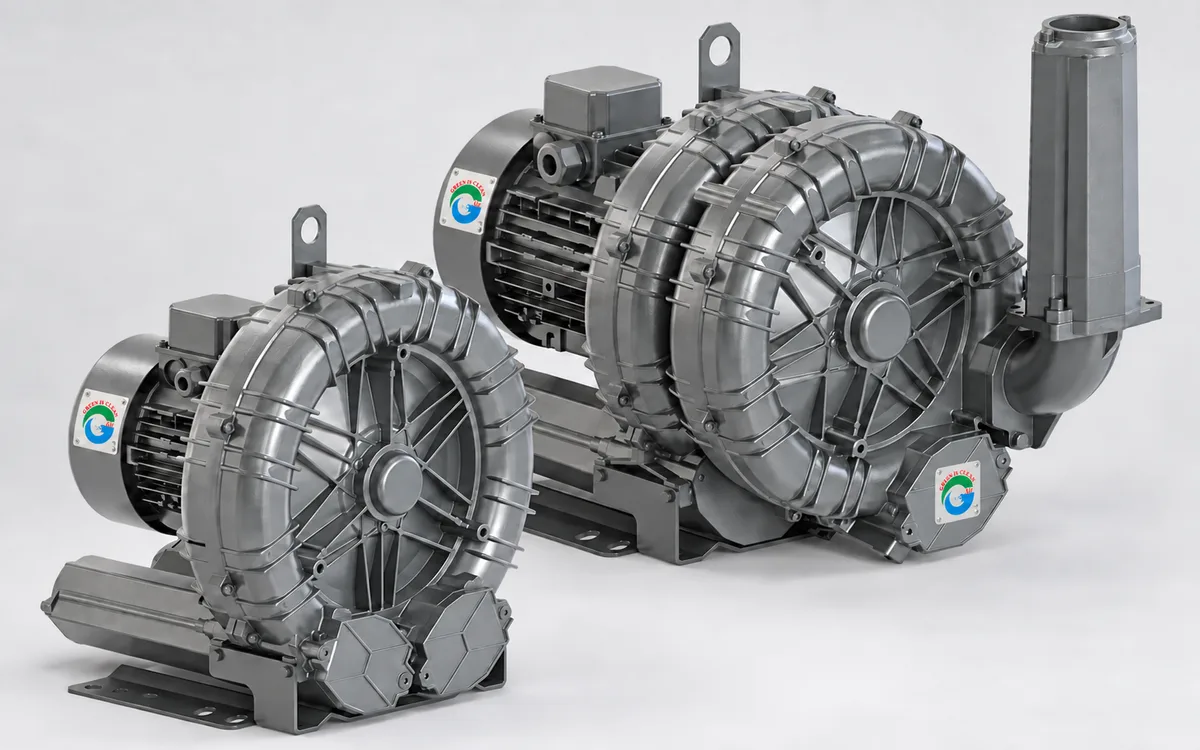
Overview
A side channel blower is an impeller in a shaped housing. There is nothing in contact, no lubricant and nothing that wears, which is why these units routinely run for a decade without being opened.
They produce a modest vacuum or a modest pressure at high flow, which is exactly what pick-and-place systems, aeration tanks and drying blowers need.
Key benefits
Effectively maintenance free
No wearing parts in the gas path. Bearings are the only scheduled item.
Vacuum or pressure
The same unit works either way, which simplifies spares across a plant.
Oil-free and clean
Nothing in the air stream, suitable for food and packaging duties.
Continuous duty
Designed to run continuously for years.
How it is built
An impeller spinning in a side channel, moving a large volume of air at a modest vacuum or pressure. There is no contact, no oil and effectively nothing to wear.
It is the simplest machine in the vacuum range and by far the most reliable when applied correctly, which means a light vacuum over a large flow rather than a deep vacuum.
The same machine runs as a blower or as a vacuum source depending on which port is connected, which is often useful on a packaging or handling line.
- Impeller in a side channel with no contact
- Large flow at a modest vacuum
- No oil and effectively nothing to wear
- Runs as blower or vacuum source
- Very low maintenance
- Air cooled
- Quiet running
- Continuous duty rated
Controls and monitoring
Motor load and temperature. On a machine this simple those two readings cover almost everything that can go wrong.
Variable speed is worth having where the process demand swings, because throttling a side channel blower wastes what it saves.
Inlet filtration is part of the control question rather than an accessory. A blocked filter shows as motor load before it shows as poor performance.
- Motor load and temperature monitored
- Variable speed where demand swings
- Throttling avoided, speed used instead
- Inlet filter condition visible in motor load
- Service countdown in hours
- Volt free contacts for plant alarms
- Remote monitoring available
- Automatic restart after a power failure
Parts and service
Inlet filters and bearings, and very little else. This is the lowest maintenance machine in the vacuum range.
Inlet filters are cheap and they protect an impeller that is not. Changing them on schedule is most of what keeps these running for a decade.
We record motor load and achieved vacuum at every visit, so a slow decline is visible rather than a surprise.
- Inlet filter elements by interval
- Bearing service on hours
- Motor load recorded at every visit
- Achieved vacuum recorded
- Lowest maintenance in the range
- Held in local stock
- Serviced with the rest of the plant
- Fixed price under a service plan
Model range
- -120 mbar
- 48 m³/h
- Noise level
- 60 dB(A)
- Weight
- 7 kg
- Dimensions L x W x H
- 216 x 198 x 209 mm
- -150 mbar
- 96 m³/h
- Noise level
- 60 dB(A)
- Weight
- 11 kg
- Dimensions L x W x H
- 256 x 247 x 247 mm
- -155 mbar
- 96 m³/h
- Noise level
- 61 dB(A)
- Weight
- 10 kg
- Dimensions L x W x H
- 271 x 246 x 252 mm
- -130 mbar
- 175 m³/h
- Noise level
- 64 dB(A)
- Weight
- 14 kg
- Dimensions L x W x H
- 269 x 285 x 355 mm
- -350 mbar
- 180 m³/h
- Noise level
- 77 dB(A)
- Weight
- 36 kg
- Dimensions L x W x H
- 448 x 482 x 355 mm
- -255 mbar
- 162 m³/h
- Noise level
- 68 dB(A)
- Weight
- 25 kg
- Dimensions L x W x H
- 543 x 302 x 316 mm
- -210 mbar
- 250 m³/h
- Noise level
- 72 dB(A)
- Weight
- 32 kg
- Dimensions L x W x H
- 352 x 334 x 388 mm
- -210 mbar
- 370 m³/h
- Noise level
- 73 dB(A)
- Weight
- 52 kg
- Dimensions L x W x H
- 510 x 638 x 434 mm
- -295 mbar
- 395 m³/h
- Noise level
- 81 dB(A)
- Weight
- 60 kg
- Dimensions L x W x H
- 703 x 395 x 415 mm
- 180 mbar
- 275 m³/h
- Noise level
- 71 dB(A)
- Weight
- 65 kg
- -360 mbar
- 620 m³/h
- Noise level
- 78 dB(A)
- Weight
- 160 kg
- Dimensions L x W x H
- 632 x 622 x 541 mm
- -360 mbar
- 1340 m³/h
- Noise level
- 76 dB(A)
- Weight
- 307 kg
- Dimensions L x W x H
- 873 x 1100 x 665 mm
- -345 mbar
- 1440 m³/h
- Noise level
- 80 dB(A)
- Weight
- 240 kg
- Dimensions L x W x H
- 1352 x 615 x 631 mm
- -180 mbar
- 2640 m³/h
- Noise level
- 84 dB(A)
- Weight
- 166 kg
- Dimensions L x W x H
- 739 x 600 x 610 mm
FAD measured to ISO 1217 Edition 4, Annex C and E at 1 bar a intake, 20°C, 0% humidity. Noise measured to ISO 2151 in free field conditions, tolerance ± 3 dB(A). Water-cooled versions of every model are available. Ask us for their sheet.
Frequently asked questions
What is a side channel blower?
A compact machine where an impeller repeatedly accelerates air around a side channel, building pressure or vacuum in a single, simple stage.
What duty does it suit?
Continuous low-pressure or low-vacuum work, packaging suction, small conveying, aquaculture aeration, printing and dental or laboratory vacuum.
How much pressure or vacuum?
Typically up to a few hundred millibar either way. Beyond that a claw or rotary vane machine is the correct choice.
Is it oil-free?
Yes, completely. There is no contact between the impeller and the housing, so there is nothing to lubricate in the air path.
What maintenance does it need?
Almost none: an inlet filter and eventually bearings. That is one of the main reasons people specify them.
Can it run continuously?
Yes, that is what it is designed for. What it does not like is running against a fully closed valve, which overheats it quickly.
Why does mine get so hot?
Usually because it is running deadheaded or the inlet filter is blocked. Both raise the air temperature fast and both are easy to design out.
Can one machine do pressure and vacuum?
It can do either, but not both at once. The connection determines which, and the duty point must be one or the other.
Is it noisy?
There is a characteristic high-frequency tone. Inlet and outlet silencers deal with it and are usually worth fitting from the start.
Can it handle dust or moisture?
Only with proper inlet filtration or separation. Debris reaching the impeller is the single commonest cause of failure in these machines.
Related products
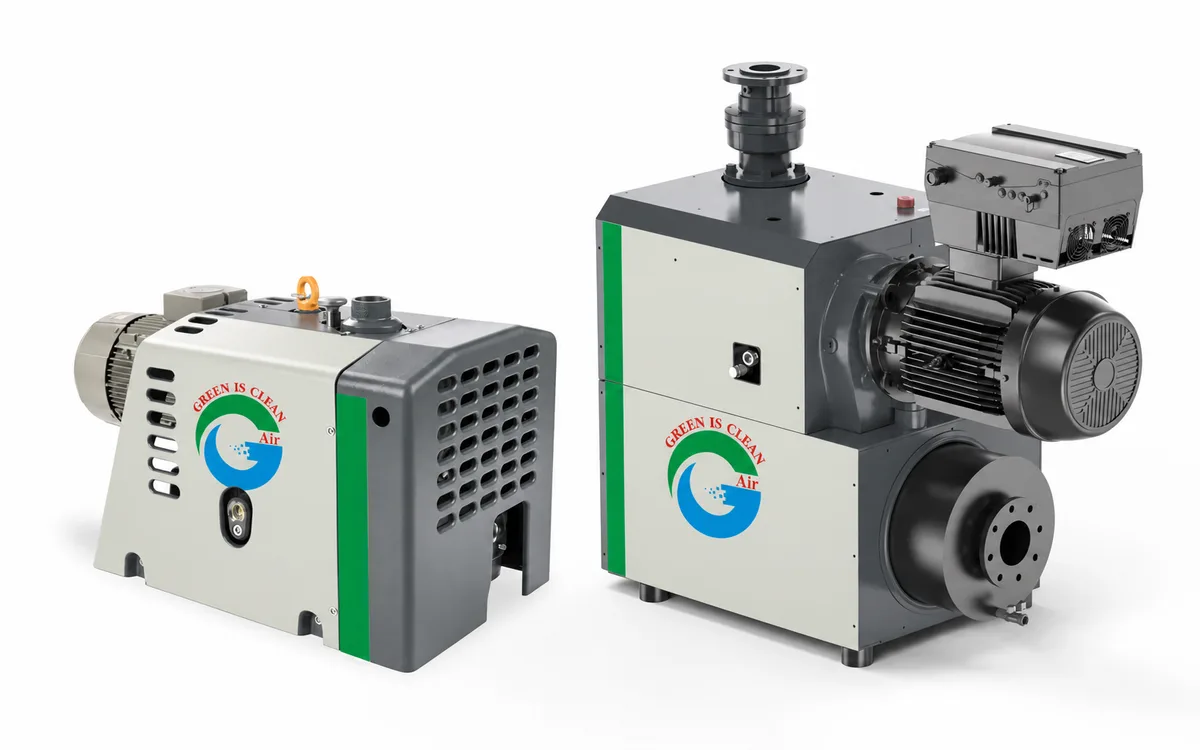
Dry claw vacuum pumps
Contact-free claw rotors for continuous, oil-free rough vacuum.
- Working pressure
- 20 – 450 bar g
- Motor power
- 1 – 25 kW
- Weight
- 7 – 950 kg
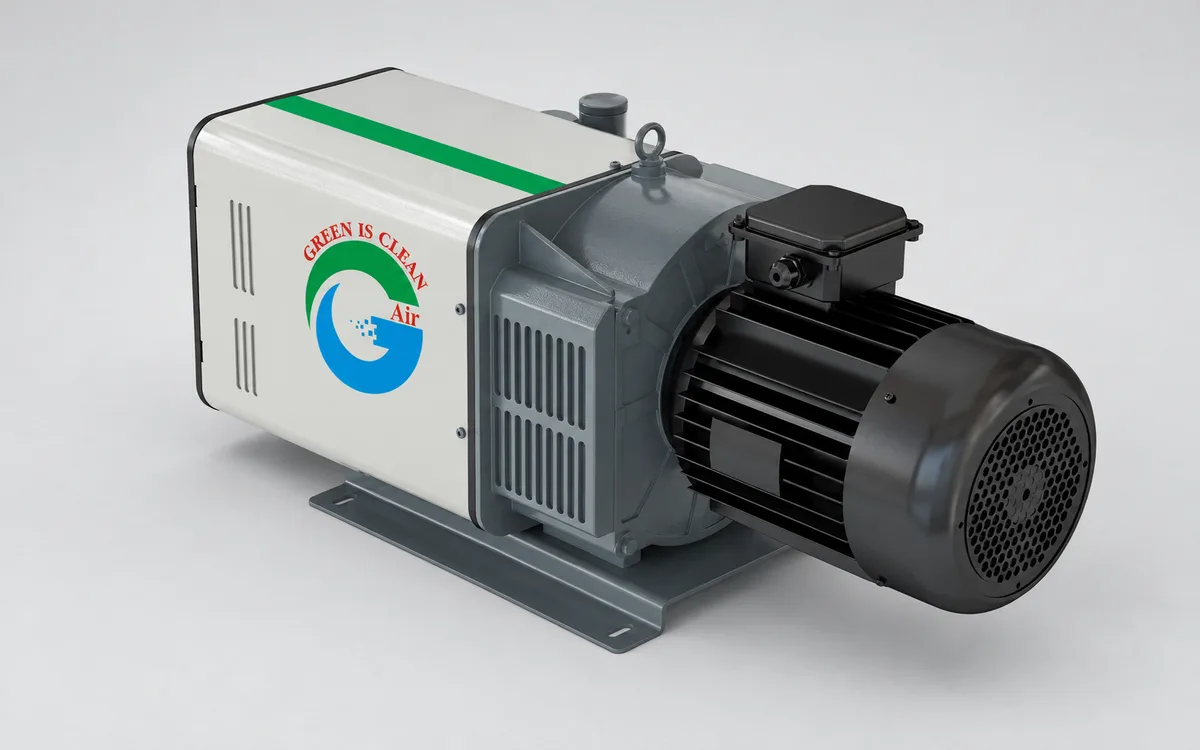
Dry rotary vane vacuum pumps
Simple, compact oil-free pumps for light and intermittent duty.
- Working pressure
- 100 – 150 bar g
- Motor power
- 0 – 8 kW
- Weight
- 5 – 140 kg
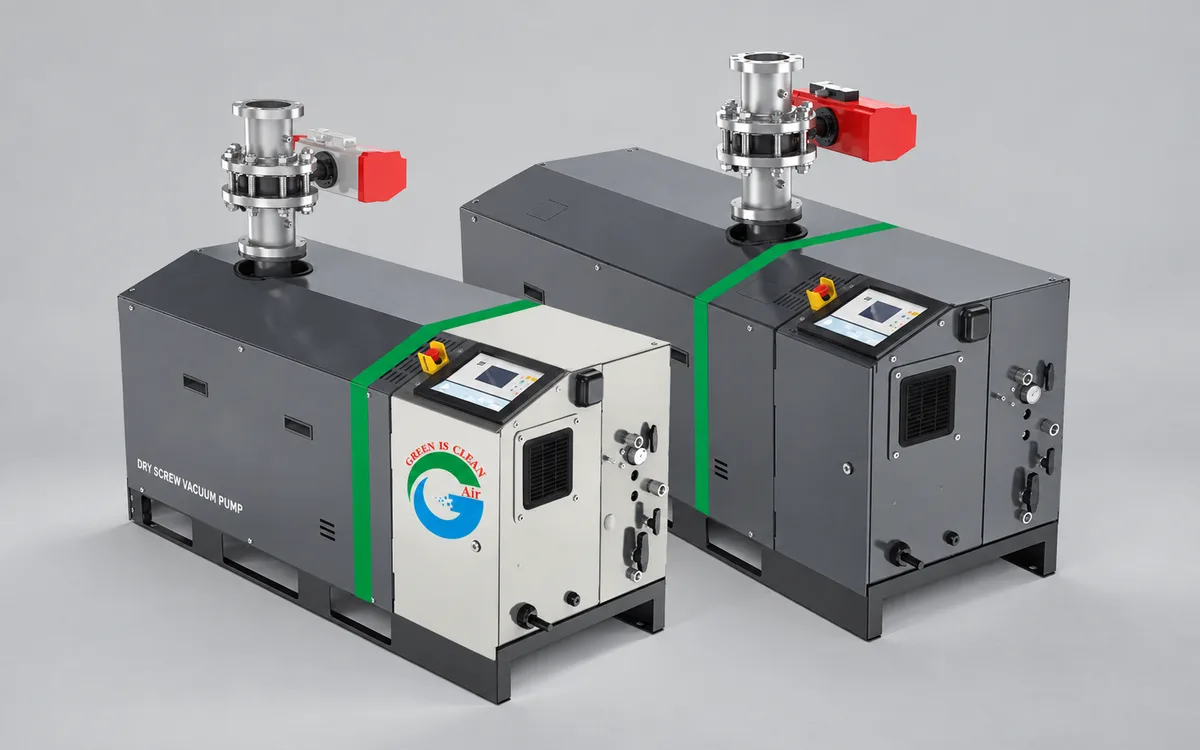
Dry screw vacuum pumps
Deep, dry vacuum that tolerates vapour and process carry-over.
- Working pressure
- 0 – 20 bar g
- Motor power
- 4 – 63 kW
- Weight
- 250 – 2,750 kg
Dry scroll vacuum pumps
Quiet, clean pumps for laboratories and analytical instruments.
- Free air delivery
- 42 – 59 cfm
- Working pressure
- 2 bar g
- Motor power
- 2 – 2 kW
Not sure which model you need?
Send us your air demand, working pressure and running hours. Our engineers will size the machine and send a written recommendation, no cost, no obligation.