
Dry screw vacuum pumps
Deep, dry vacuum that tolerates vapour and process carry-over.
Technical data
- Working pressure
- 0 – 20 bar g
- Motor power
- 4 – 63 kW
- Weight
- 250 – 2,750 kg
- Noise level
- 62 – 84 dB(A)
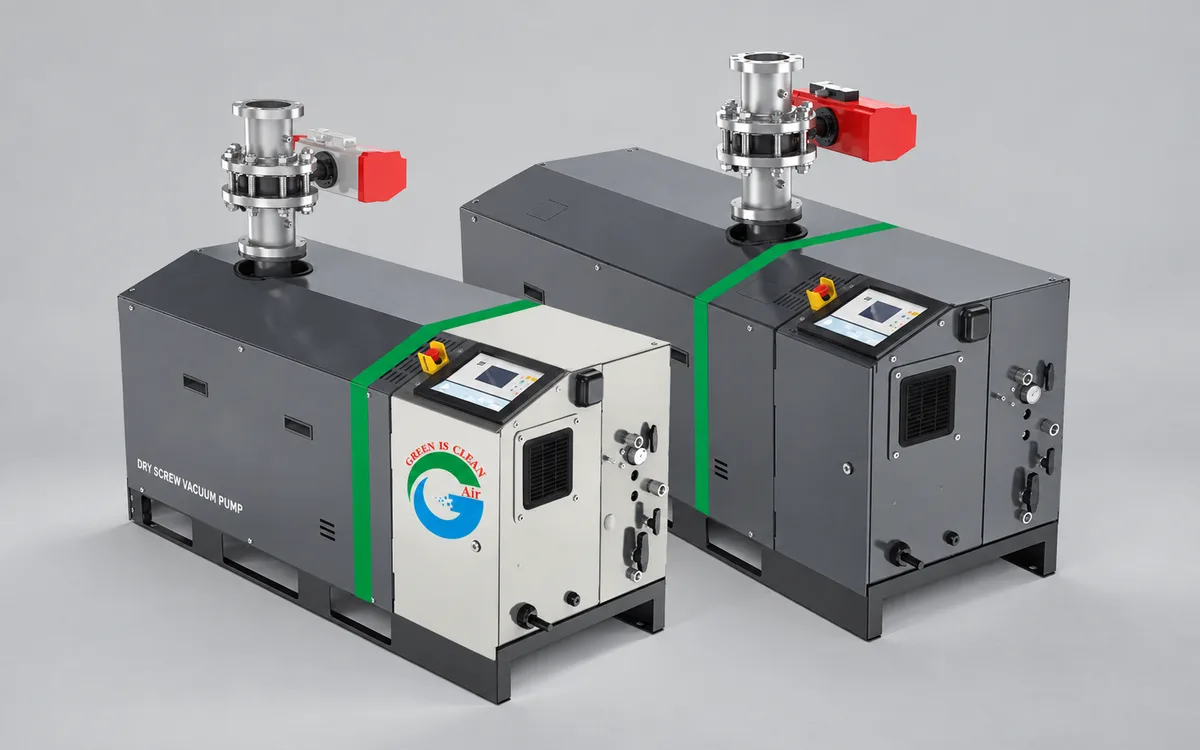
Overview
A dry screw pump reaches a much deeper vacuum than a claw pump, down to 0.01 mbar, with nothing in the chamber. That combination is what chemical and pharmaceutical processes need, because the process vapour must not be contaminated and the pump must not be destroyed by it.
Because there is no oil, condensable vapours pass straight through instead of being absorbed. On solvent recovery and drying duties that removes the entire problem of oil degradation.
Key benefits
Down to 0.01 mbar
Deep vacuum without a backing pump on most process duties.
Handles vapour and solvent
No oil to be contaminated, so solvent recovery does not destroy the pump.
Purge and heating options
Nitrogen purge and jacket heating available for sticky or condensing processes.
Recover your product
Because nothing is absorbed into oil, condensable product can be recovered downstream.
How it is built
Two screws turning without contact, which is the same principle as a screw compressor run the other way round. It is the design that handles vapour and condensable loads better than anything else dry.
Nothing touches, so nothing wears in the chamber. The bearings and the gearbox are outside the pumped gas and they are lubricated separately, which keeps the process clean.
The pumping chamber can be purged and can be heated on duties where a process would otherwise condense inside the pump. That is why these are the usual answer on chemical and pharmaceutical work.
- Non contacting screw rotors
- Bearings and gears outside the pumped gas
- Handles vapour and condensable loads
- Chamber purge and heating available
- Deep ultimate vacuum
- Corrosion resistant coatings available
- Air cooled or water cooled
- Variable speed available
Controls and monitoring
Vacuum level, motor load, chamber temperature and the purge, because on a condensable duty the purge is what keeps the pump alive.
Chamber temperature is controlled rather than merely watched. Running the pump warm is how a condensable process is prevented from becoming a liquid inside it.
Alarms on temperature, on loss of vacuum and on purge failure, with volt free contacts for the plant system.
- Vacuum level and motor load
- Chamber temperature controlled, not just watched
- Purge monitored and alarmed
- Variable speed follows the process
- Service countdown in hours
- Volt free contacts for plant alarms
- Remote monitoring available
- Fault history kept on the pump
Parts and service
Filters, seals and the scheduled wear items, quoted against the serial number and the process. Two identical pumps on different duties do not take the same interval.
A vacuum pump rarely fails without warning. Ultimate pressure drifting, a longer pump down time and a rising temperature all appear first, which is why those three are measured at every visit.
We test after service rather than simply finishing. The pump down curve and the ultimate pressure achieved go on the report, so you know what you have rather than what was intended.
- Filter and seal kits by interval
- Intervals set by the process, not the calendar
- Ultimate pressure tested after every service
- Pump down curve recorded
- Confirmed against your serial number
- Held in local stock
- Workshop overhaul where testing is needed
- Fixed price under a service plan
Model range
- 3.0 · 10⁻² mbar
- 85 m³/h
- Noise level
- 62 dB(A)
- Weight
- 250 kg
- Dimensions L x W x H
- 809 x 483 x 416 mm
- ≤ 0.01 mbar
- 130 m³/h
- Noise level
- ≤ 74 dB(A)
- Weight
- 300 kg
- Dimensions L x W x H
- 1127 x 520 x 595 mm
- ≤ 0.01 mbar
- 265 m³/h
- Noise level
- ≤ 76 dB(A)
- Weight
- 350 kg
- Dimensions L x W x H
- 1264 x 520 x 607 mm
- ≤ 0.01 mbar
- 385 m³/h
- Noise level
- ≤ 77 dB(A)
- Weight
- 400 kg
- Dimensions L x W x H
- 1334 x 520 x 607 mm
- ≤ 0.01 mbar
- 420 m³/h
- Noise level
- 69 dB(A)
- Weight
- 500 kg
- Dimensions L x W x H
- 1367 x 480 x 700 mm
- ≤ 0.1 mbar
- 420 m³/h
- Noise level
- 70 dB(A)
- Weight
- 600 kg
- Dimensions L x W x H
- 1358 x 494 x 746 mm
- ≤ 0.01 mbar
- 600 m³/h
- Noise level
- ≤ 76 dB(A)
- Weight
- 600 kg
- Dimensions L x W x H
- 1502 x 602 x 640 mm
- ≤ 0.01 mbar
- 630 m³/h
- Noise level
- 75 dB(A)
- Weight
- 600 kg
- Dimensions L x W x H
- 1502 x 602 x 640 mm
- < 20 mbar
- 680 m³/h
- Noise level
- 78 dB(A)
- Weight
- 880 kg
- Dimensions L x W x H
- 1683 x 720 x 861 mm
- ≤ 0.1 mbar
- 650 m³/h
- Noise level
- 75 dB(A)
- Weight
- 800 kg
- Dimensions L x W x H
- 1538 x 538 x 771 mm
- ≤ 0.01 mbar
- max. 950 m³/h
- 0.01 mbar
- 950 m³/h
- Noise level
- ≤ 75 dB(A)
- Weight
- 1125 kg
- Dimensions L x W x H
- 1700 x 700 x 1000 mm
- ≤ 0.01 mbar
- 1900 m³/h
- Noise level
- ≤ 76 dB(A)
- Weight
- 2750 kg
- Dimensions L x W x H
- 2035 x 983 x 1950 mm
- ≤ 1.0 mbar
- 2500 m³/h
- Noise level
- 84 dB(A)
- Weight
- 2500 kg
- Dimensions L x W x H
- 2243 x 1053 x 1437 mm
FAD measured to ISO 1217 Edition 4, Annex C and E at 1 bar a intake, 20°C, 0% humidity. Noise measured to ISO 2151 in free field conditions, tolerance ± 3 dB(A). Water-cooled versions of every model are available. Ask us for their sheet.
Frequently asked questions
Where does a dry screw pump fit?
Where you need deeper vacuum than a claw can reach but still want no oil in the process: chemical, pharmaceutical and demanding industrial duties.
What vacuum does it achieve?
Down to around 0.01 mbar in multi-stage arrangements, and comfortably into the single-figure mbar range as a single machine.
Why no oil in the chamber?
The rotors are timed by gears and never touch. Lubrication is confined to the bearing and gear end, sealed away from the pumped gas.
Can it handle vapour and solids?
Better than most dry technologies. Variable pitch rotors and purge arrangements let it cope with condensables that would ruin an oil-sealed pump.
Is it suitable for corrosive processes?
With the correct coatings and materials, yes. Tell us the process chemistry at enquiry, because it decides the whole specification.
How is it cooled?
Water or air jacket cooling, depending on duty. Compression heat is significant in deep vacuum work and cooling is not an optional extra.
What maintenance does it need?
Gear oil, seals and periodic internal inspection. Process residue is what usually decides the interval, not running hours.
How does the running cost compare?
Higher purchase price than oil-sealed, lower total cost where oil disposal, filtration and contamination risk are counted properly.
Can it be cleaned in place?
Many configurations support purge and cleaning routines. For sticky or polymerising processes that capability is usually essential.
Is it worth the extra cost?
Where product contamination or oil waste matters, yes, and the arithmetic is usually clear. Where neither matters, an oil-sealed pump may be the honest answer.
Not sure which model you need?
Send us your air demand, working pressure and running hours. Our engineers will size the machine and send a written recommendation, no cost, no obligation.