
Rotary screw air compressors
The default choice for continuous industrial air, 2.2 to 250 kW.
Overview
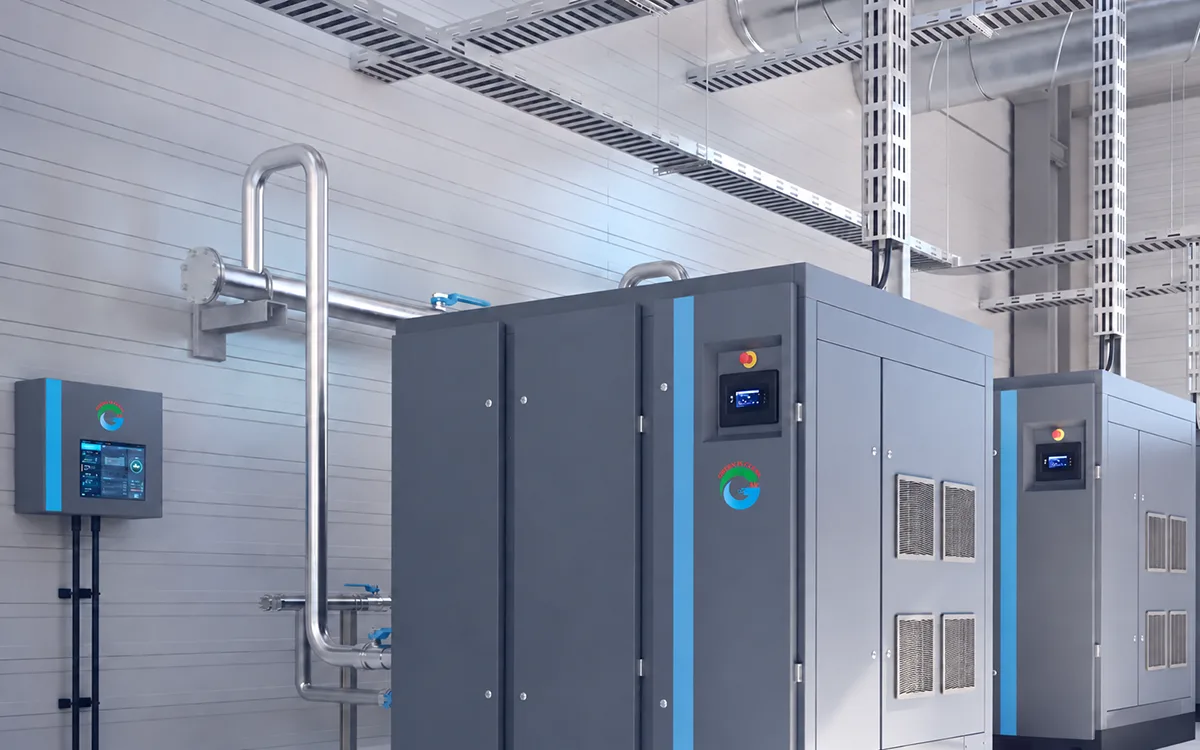
A rotary screw compressor uses two meshing helical rotors to squeeze air continuously as it passes through. There is no stop-start of a piston, no vibration to speak of, and no reason it cannot run twenty-four hours a day.
That is why it is the standard industrial machine. Our range runs from a 2.2 kW workshop unit to a 250 kW two-stage plant room machine, in fixed and variable speed, air and water cooled.
In this range
- Direct driven screw compressorsMotor coupled straight to the airend. 55 to 250 kW, nothing to slip.
- Variable speed screw compressorsThe motor follows the demand. 7.5 to 280 kW, 8 to 13 bar g.
- Two stage screw compressorsCompression in two steps. 45 to 500 hp, 4.5 to 12.5 bar g.
- Permanent magnet screw compressorsIE4 and IE5 class motors with variable speed built in. 20 to 500 hp.
- Low pressure screw compressors2 to 4.5 bar g, where a standard machine would waste a third of its energy.
- Medium pressure screw compressors13 to 25 bar g without a separate booster stage.
- High pressure screw compressors20 to 35 bar g from a screw machine. 45 to 330 kW.
- Single phase screw compressorsScrew air where there is no three phase supply. 2.2 to 7.5 kW.
- 2.2 – 5.5 kW screw compressorsQuiet, tank-mounted units for workshops and small production lines.
- 7.5 – 22 kW screw compressorsThe workhorse range for most small and medium factories.
- 23 – 29 kW screw compressorsA step up in flow without moving to a larger plant room.
- 30 – 45 kW screw compressorsMid-size plant room machines with full remote monitoring.
- 55 – 75 kW screw compressorsHigh-flow machines for continuous, multi-shift production.
- 90 – 132 kW screw compressorsPlant-room class machines where energy cost dominates.
- 160 – 250 kW screw compressorsLarge fixed and variable speed units for heavy industry.
Key benefits
Continuous duty
Designed to run at 100% load indefinitely, unlike a piston machine which needs rest periods.
Choose by demand pattern
Fixed speed for steady loads, variable speed where demand swings. We will tell you which from your data.
One service platform
Common filters, oil and separators across large parts of the range keeps your spares holding small.
Hot climate rated
46 °C ambient as standard across the range, with a 52 °C package for uncooled plant rooms.
How a screw compressor works
Two rotors mesh and the air trapped between them is carried along and squeezed into a smaller volume as it travels towards the discharge.
Because that is continuous rather than reciprocating, there is no pulse in the delivery and no duty cycle to respect. A screw compressor is rated to run all day.
Oil injected machines use oil to seal, cool and lubricate, then separate most of it out again. Oil free machines time the rotors with gears so they never touch.
- Continuous compression, no pulsation
- Rated for one hundred per cent duty
- Oil injected for general industrial air
- Oil free where air contacts product
- Fixed or variable speed
- Single stage or two stage
- Air cooled or water cooled
- 40,000 to 60,000 hours before overhaul
Choosing within the range
Single stage up to about ten bar, two stage above it or wherever running hours are long enough for the eight to twelve per cent energy difference to matter.
Variable speed where demand swings, which in most factories it does. On a constantly loaded process line it may never pay and we will say so.
Water cooling where the plant room cannot take the heat, which in a Gulf summer is more often than people expect.
- Single stage to about 10 bar
- Two stage above that or for long hours
- Variable speed where demand swings
- Fixed speed on constant loads
- Water cooling where heat is a problem
- Heat recovery where hot water is used
- Sequencing across several machines
- Sized from a week of measurement
Datasheets in this range
Two pages each: what the machine is, what it is for, and the measured table. Built from this site, so a sheet can never say something the page does not.
- PDFDirect driven screw compressors
- PDFVariable speed screw compressors
- PDFTwo stage screw compressors
- PDFPermanent magnet screw compressors
- PDFLow pressure screw compressors
- PDFMedium pressure screw compressors
- PDFHigh pressure screw compressors
- PDFSingle phase screw compressors
- PDF2.2 – 5.5 kW screw compressors
- PDF7.5 – 22 kW screw compressors
- PDF23 – 29 kW screw compressors
- PDF30 – 45 kW screw compressors
- PDF55 – 75 kW screw compressors
- PDF90 – 132 kW screw compressors
- PDF160 – 250 kW screw compressors
Frequently asked questions
How does a rotary screw compressor work?
Two helical rotors mesh together and trap air between themselves and the housing. As the air travels along the rotors that trapped space gets smaller, so the air is squeezed continuously rather than in pulses.
Why is a screw compressor better than a piston for continuous use?
There is no reciprocating mass, so no impact loading and almost no vibration. That is why a screw machine is rated for a 100% duty cycle while a piston machine needs to rest 30–40% of the time.
How often does the oil need changing?
Mineral oil every 2,000 hours, semi-synthetic every 4,000, full synthetic every 8,000. In Gulf and Pakistani ambient temperatures synthetic usually works out cheaper per hour despite costing more per litre.
What is an airend and how long does it last?
The airend is the rotor pair and their housing, the actual compressor. With correct oil and filtration it runs 40,000 hours or more. We hold rebuilt exchange airends so a replacement is a next-day job rather than a six-week repair.
Fixed speed or variable speed?
Fixed speed if the machine runs loaded nearly all the time. It is cheaper and marginally more efficient at full load. Variable speed if demand swings, because an unloaded fixed-speed machine still draws 25–35% of full power for no air at all.
Can it really run 24 hours a day?
Yes, continuous duty is what the design is for, and many of our installations run 8,000 hours a year. What shortens life is not hours but heat, dirty intake air and skipped oil changes.
What makes a screw compressor run hot?
Almost always airflow, not the machine. A blocked cooler, a dirty intake filter, recirculating hot discharge air, or a plant room without enough ventilation. Check those before assuming the compressor is at fault.
Air-cooled or water-cooled?
Air-cooled below about 90 kW, unless the plant room cannot get rid of the heat. Above that, water cooling takes the heat out of the room entirely, which in a Gulf summer is often the difference between a machine that runs and one that trips.
Can I recover the heat?
Yes, up to 76% of the electrical input comes back as hot water at around 70 °C. On a 45 kW machine running two shifts that is enough to pre-heat boiler feed water. We calculate it from your running hours before recommending it.
What is the real running cost?
Take the kW, multiply by running hours and your tariff. A 37 kW machine at 6,000 hours a year on a typical industrial tariff costs many times its purchase price over ten years, which is why specific energy, in kW per m³/min, matters more than the quoted price.
Related products
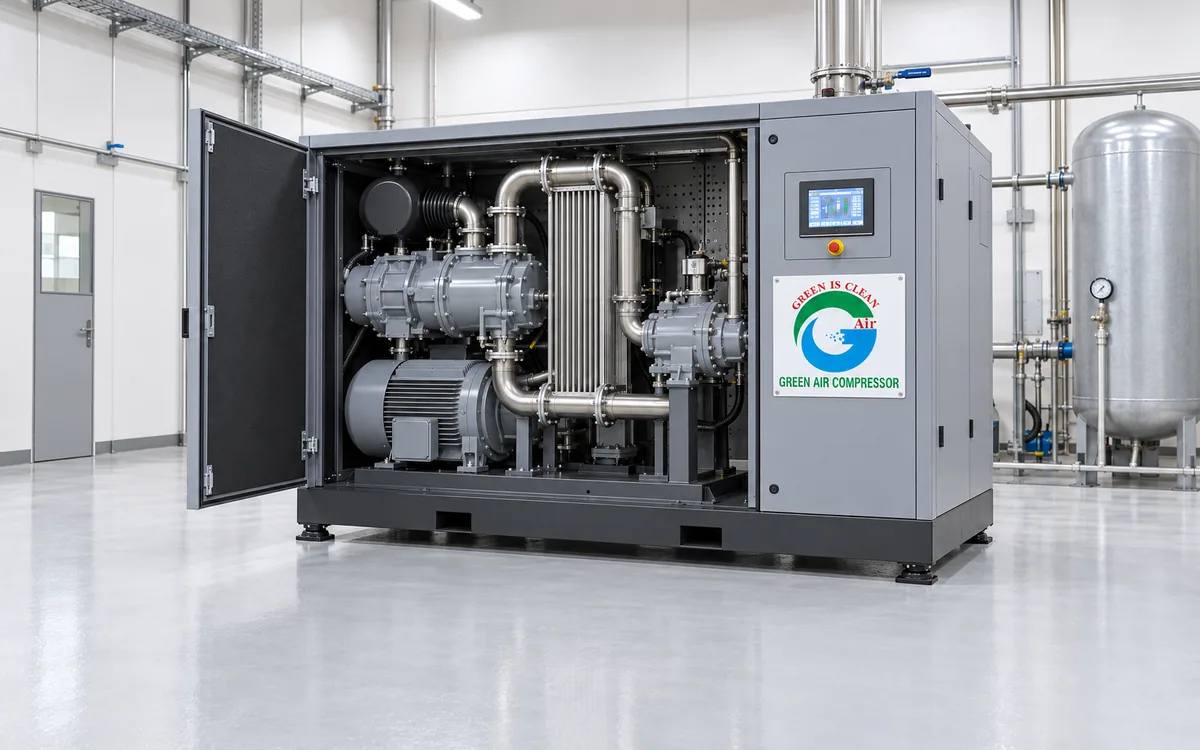
Oil-free air compressors
Certified Class 0 air for food, pharma, electronics and textiles.
- Free air delivery
- 0.3 – 53.3 m³/min
- Working pressure
- 4 – 10 bar g
- Motor power
- 6 – 355 kW
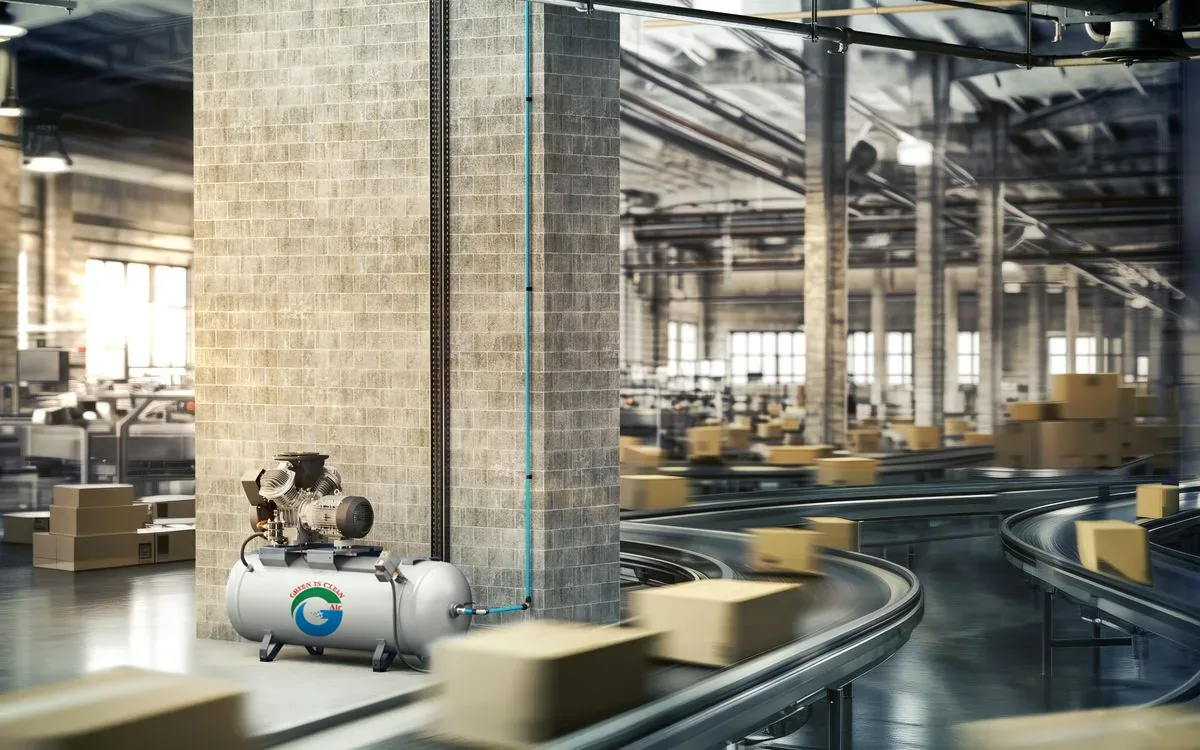
Piston air compressors
Reciprocating machines for intermittent and high-pressure duties.
- Free air delivery
- 0.1 – 25.0 m³/min (229 – 882 cfm)
- Working pressure
- 10 – 1,000 bar g
- Motor power
- 2 – 250 kW
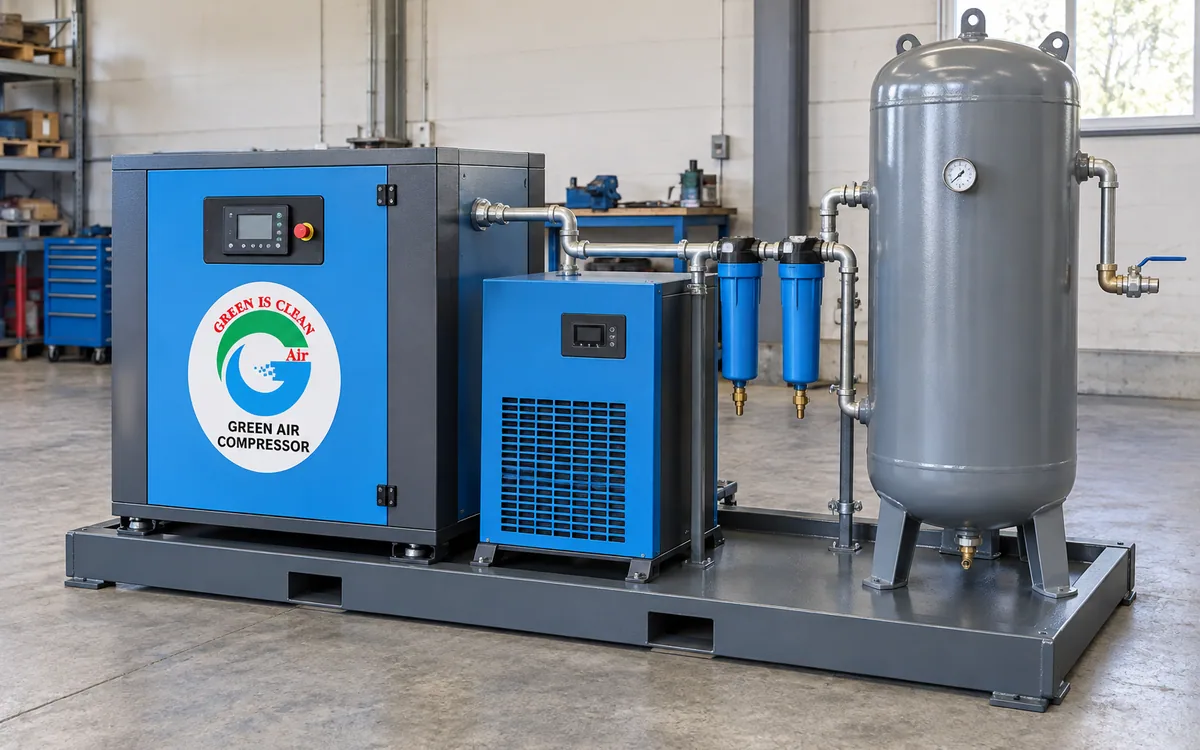
Packaged and integrated air stations
Compressor, dryer, filters and receiver supplied as one item.
- Free air delivery
- 0.3 – 25.0 m³/min (9 – 64 cfm)
- Working pressure
- 7 – 30 bar g
- Motor power
- 4 – 250 kW
Not sure which model you need?
Send us your air demand, working pressure and running hours. Our engineers will size the machine and send a written recommendation, no cost, no obligation.