
Oil-free rotary screw compressors
Class 0 air with no oil anywhere in the compression chamber.
Technical data
- Free air delivery
- 0.3 – 6.9 m³/min
- Working pressure
- 5 – 10 bar g
- Motor power
- 15 – 37 kW
- Weight
- 624 – 995 kg
- Noise level
- 61 – 71 dB(A)
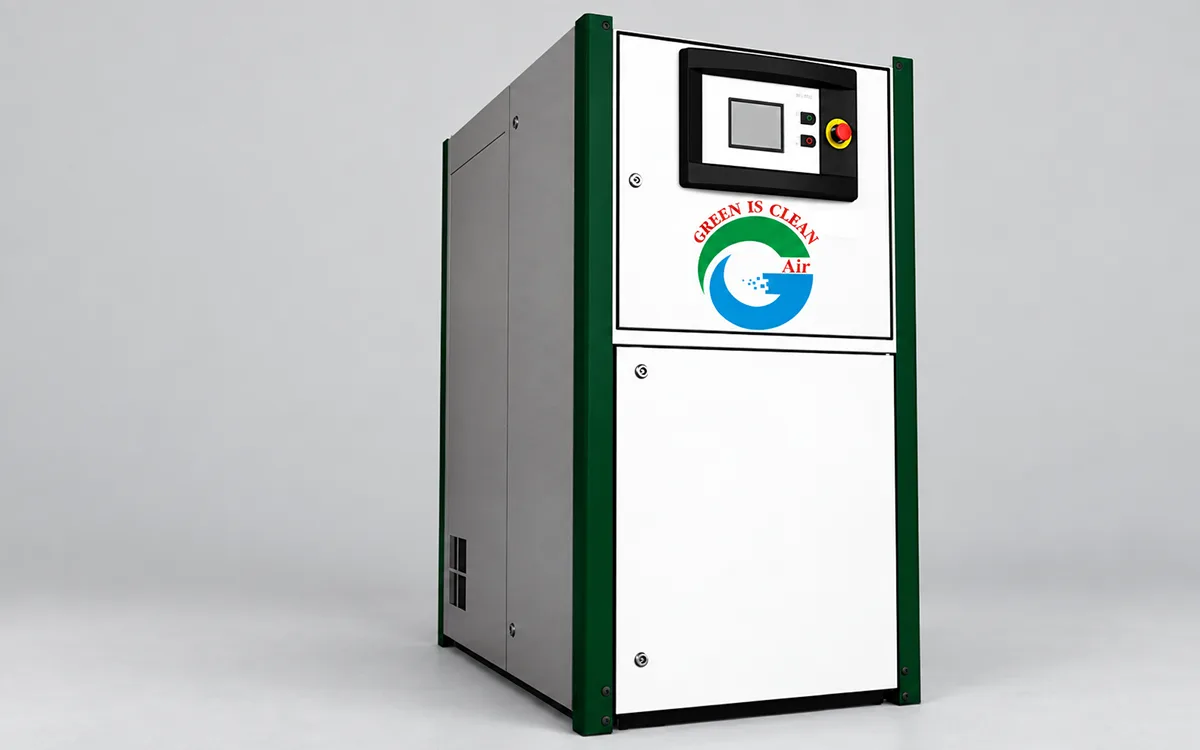
Overview
There is an important difference between air that has been filtered until it is nearly oil-free and air that never touched oil. If your product is food, medicine, electronics or textiles, only the second one protects you, a filter element that fails silently does not announce itself until the batch is ruined.
Green Air oil-free screw compressors use precision-timed rotors that never touch each other or any lubricant. The result is certified ISO 8573-1 Class 0 air: not a low oil content, but no measurable oil content at all.
Key benefits
Certified Class 0
Independently tested to ISO 8573-1 Class 0 for total oil, including vapour. Certificate supplied with every machine.
No condensate to treat
Nothing oily leaves the machine, so there is no oil-water separator to buy, maintain or explain to an environmental inspector.
No filtration pressure drop
You are not pushing air through three stages of coalescing filters, which typically saves 0.4 bar and the energy that goes with it.
Lower risk, not just lower oil
Removes the single point of failure that ruins batches in food, pharma and electronics plants.
How it is built
Two rotors turn in the housing without ever touching each other and without any lubricant between them. Timing gears hold the clearance, and the clearance is held by manufacturing accuracy rather than by a film of oil.
Because nothing is sprayed into the chamber to carry heat away, the heat has to leave through the casing and the intercooler instead. That is why an oil free machine is physically larger than an oil injected one of the same output, and why the cooling design is the part that decides how long it lasts.
The rotor coating is the wearing part, not a bearing surface. Kept within its temperature limits it lasts many years, and the controller exists largely to keep it there.
- Timed rotors that never touch
- No lubricant anywhere in the air path
- Certified to ISO 8573-1 Class 0
- Intercooling between stages
- Air cooled or water cooled
- No oil water separator needed downstream
- No coalescing filter pressure drop to pay for
- Variable speed available
What the controller does
The controller watches the temperatures that matter to a coated rotor and shuts the machine down before they matter, which is a different job from the one a controller does on an oil injected machine.
Pressure, load, running hours, both stage temperatures and the service countdown are on the home screen. The stage temperature trend is the number an engineer reads, because it moves long before anything fails.
It sequences with other machines, holds a pressure band rather than a single number, and runs to a shift clock so the plant is not making Class 0 air at three in the morning for nobody.
- Both stage temperatures monitored and trended
- Pressure band control
- Service countdown in hours
- Sequencing with other machines
- Shift clock for start and stop
- Remote monitoring as standard
- Fault history kept on the machine
- Automatic restart after a power failure
Parts and service kits
Kits for an oil free machine are mostly filters, seals and bearing service rather than separators and fluid, because there is no oil in the air path to separate.
The gearbox and the bearings are the scheduled items. They are changed on hours rather than on condition, and doing that on time is what keeps a rotor coating intact.
Every kit is confirmed against the serial number. We also supply the Class 0 certificate with the machine and again after any work that could affect it, because an audit will ask for it.
- Air filters and seal kits by interval
- Scheduled bearing and gearbox service
- Intercooler clean included
- Class 0 certificate supplied and reissued after works
- Confirmed against your serial number
- Local stock in every country we trade in
- Airend exchange available
- Fixed price under a service plan
Model range
Air cooled
- 8 bar g
- 2.30 m³/min
- Noise level
- 68 dB(A)
- Weight
- 672 kg
- Dimensions L x W x H
- 1309 × 848 × 1612 mm
- 8 bar g
- 3.50 m³/min
- Noise level
- 68 dB(A)
- Weight
- 691 kg
- Dimensions L x W x H
- 1309 × 848 × 1612 mm
- 8 bar g
- 5.86 m³/min
- Noise level
- 71 dB(A)
- Weight
- 960 kg
- Dimensions L x W x H
- 1686 × 886 × 1657 mm
Water cooled
- 8 bar g
- 2.30 m³/min
- Noise level
- 65 dB(A)
- Weight
- 624 kg
- Dimensions L x W x H
- 1309 × 848 × 1612 mm
- 8 bar g
- 3.50 m³/min
- Noise level
- 65 dB(A)
- Weight
- 643 kg
- Dimensions L x W x H
- 1309 × 848 × 1612 mm
- 8 bar g
- 5.86 m³/min
- Noise level
- 61 dB(A)
- Weight
- 860 kg
- Dimensions L x W x H
- 1686 × 886 × 1657 mm
Variable speed
- 5 – 10 bar g
- 0.32 – 2.34 m³/min
- Noise level
- 67 dB(A)
- Weight
- 687 kg
- Dimensions L x W x H
- 1309 × 848 × 1612 mm
- 5 – 10 bar g
- 0.68 – 3.45 m³/min
- Noise level
- 67 dB(A)
- Weight
- 687 kg
- Dimensions L x W x H
- 1309 × 848 × 1612 mm
- 5 – 10 bar g
- 1.09 – 6.87 m³/min
- Noise level
- 71 dB(A)
- Weight
- 995 kg
- Dimensions L x W x H
- 1722 × 920 × 1659 mm
FAD measured to ISO 1217 Edition 4, Annex C and E at 1 bar a intake, 20°C, 0% humidity. Noise measured to ISO 2151 in free field conditions, tolerance ± 3 dB(A). Water-cooled versions of every model are available. Ask us for their sheet.
Frequently asked questions
How do the rotors avoid touching without oil?
They are held in mesh by precision timing gears, so they never contact each other or the housing. That is why the tolerances and the price are both higher.
What certificate comes with the machine?
An ISO 8573-1 Class 0 certificate covering total oil content including vapour, issued from independent testing.
What is the rotor coating for?
It seals the small clearances and resists corrosion in place of oil. Coating condition is what the scheduled inspection actually checks.
How long do these machines last?
Comparable to an oil-injected screw when maintained correctly. The wearing items are the bearings, seals and the coating rather than an oil circuit.
Do I lose efficiency compared with oil-injected?
At full load a single-stage oil-free machine is slightly less efficient. Two-stage recovers that and more, which is why most oil-free installations above 37 kW are two-stage.
What air quality do I actually get?
No measurable oil, plus whatever particulate and dew point your downstream treatment provides. Oil-free solves one of the three ISO classes, not all three.
Can I retrofit oil-free instead of my existing machine?
Yes, and it usually simplifies the installation: you can remove the coalescing and carbon filter stages and the oil-water separator with it.
What is the noise level?
Similar to an equivalent oil-injected machine in a canopy. Gearbox noise is the difference and it is contained within the enclosure.
Is a receiver still needed?
Yes, exactly as with any compressor: to steady pressure, catch condensate and stop short-cycling on a fixed-speed unit.
What are the running costs?
Energy dominates as always. Consumables are lower than an oil-injected machine because there is no separator element and no oil, but scheduled interventions are more specialised.
Related products
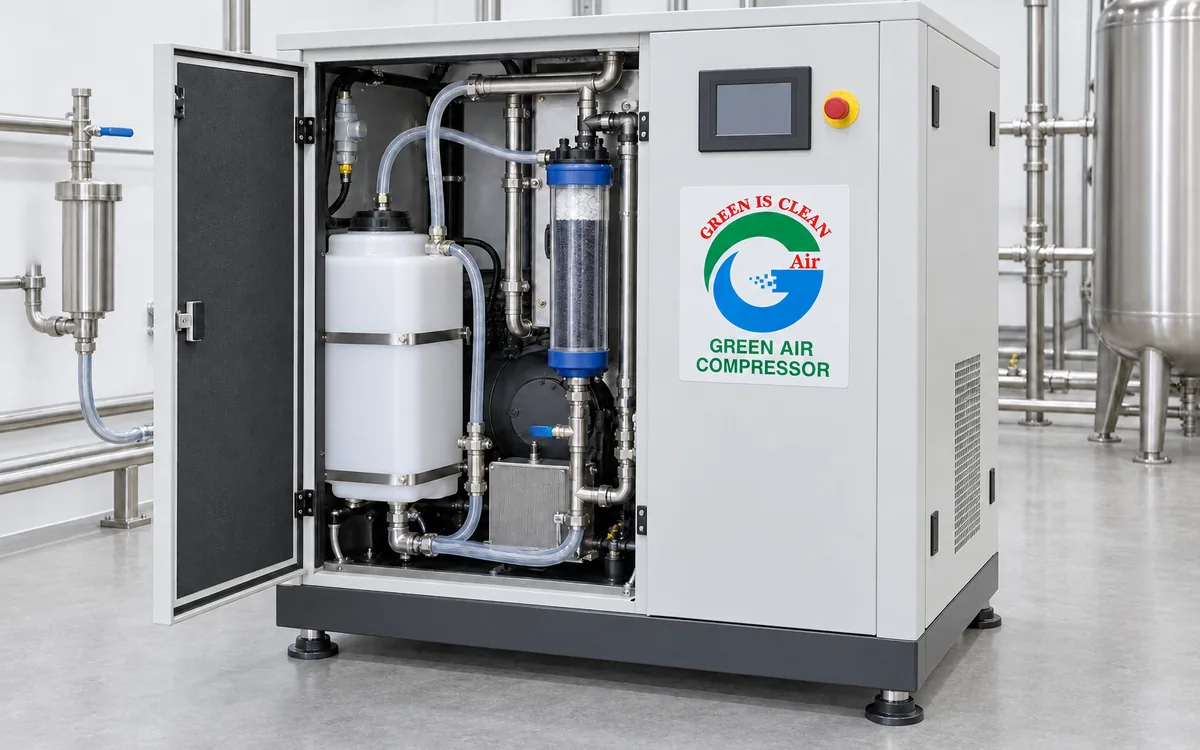
Water lubricated oil free compressors
Water seals and cools the rotors instead of oil. Class 0 air, 5.5 to 160 kW.
- Free air delivery
- 0.3 – 27.0 m³/min
- Working pressure
- 7 – 10 bar g
- Motor power
- 6 – 160 kW
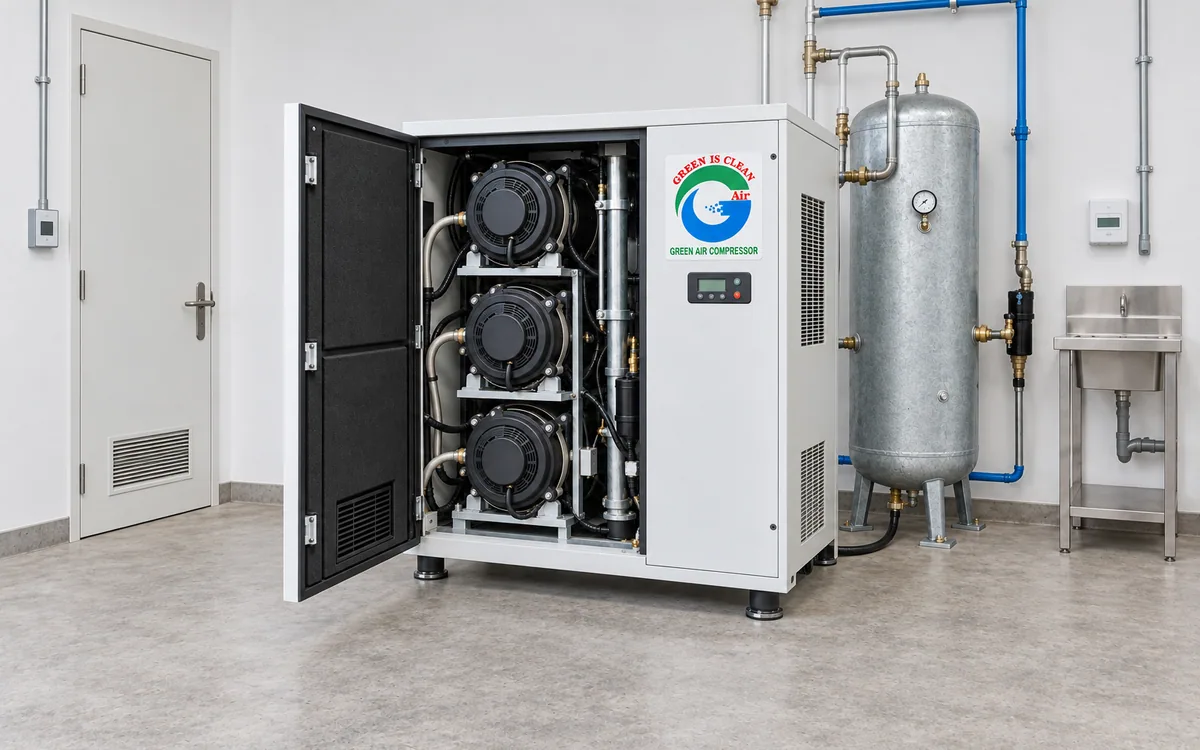
Oil free scroll compressors
Quiet, small, genuinely oil free. 7.5 to 37 kW at 8 bar g.
- Free air delivery
- 0.8 – 4.0 m³/min
- Working pressure
- 8 bar g
- Motor power
- 8 – 37 kW
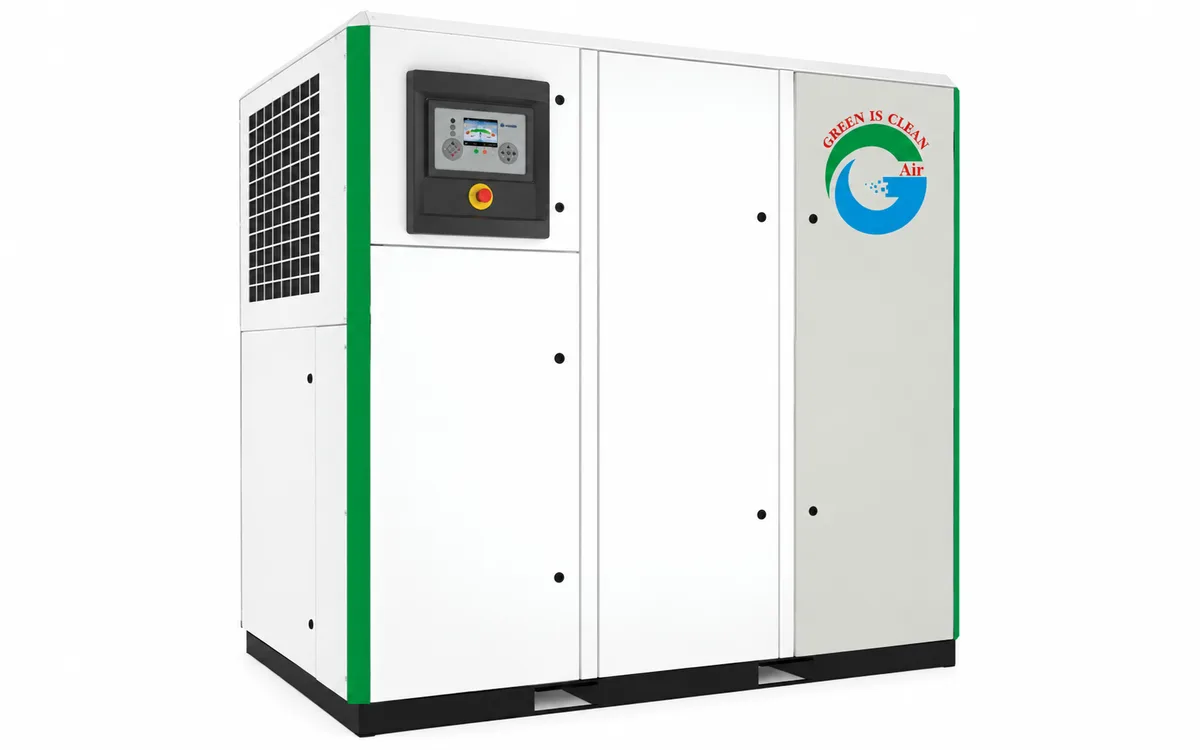
Two-stage oil-free compressors 37 – 75 kW
Two compression stages with intercooling for lower energy per m³.
- Free air delivery
- 5.1 – 12.7 m³/min
- Working pressure
- 7 – 10 bar g
- Motor power
- 37 – 75 kW
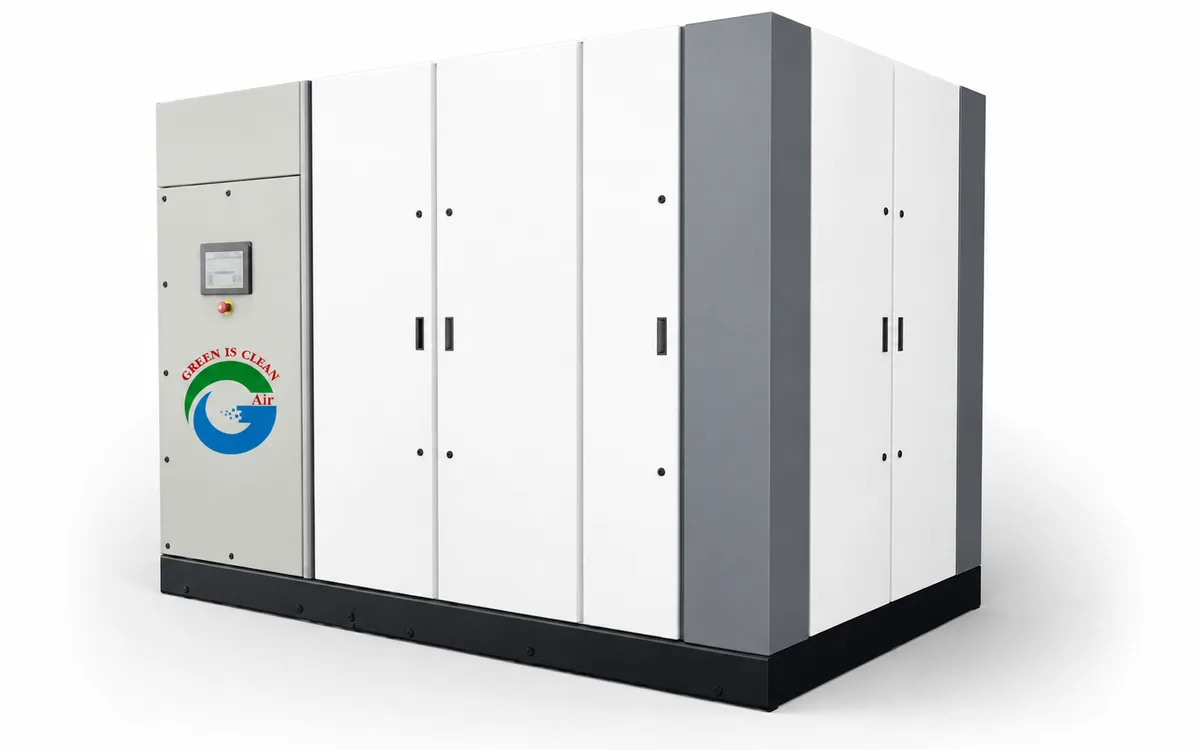
Two-stage oil-free compressors 200 – 355 kW
Large Class 0 machines for central, round-the-clock plant rooms.
- Free air delivery
- 11.6 – 53.3 m³/min
- Working pressure
- 7 – 10 bar g
- Motor power
- 200 – 355 kW
Not sure which model you need?
Send us your air demand, working pressure and running hours. Our engineers will size the machine and send a written recommendation, no cost, no obligation.