
Mechanical vapour recompression
Reuse evaporator vapour instead of condensing it away.
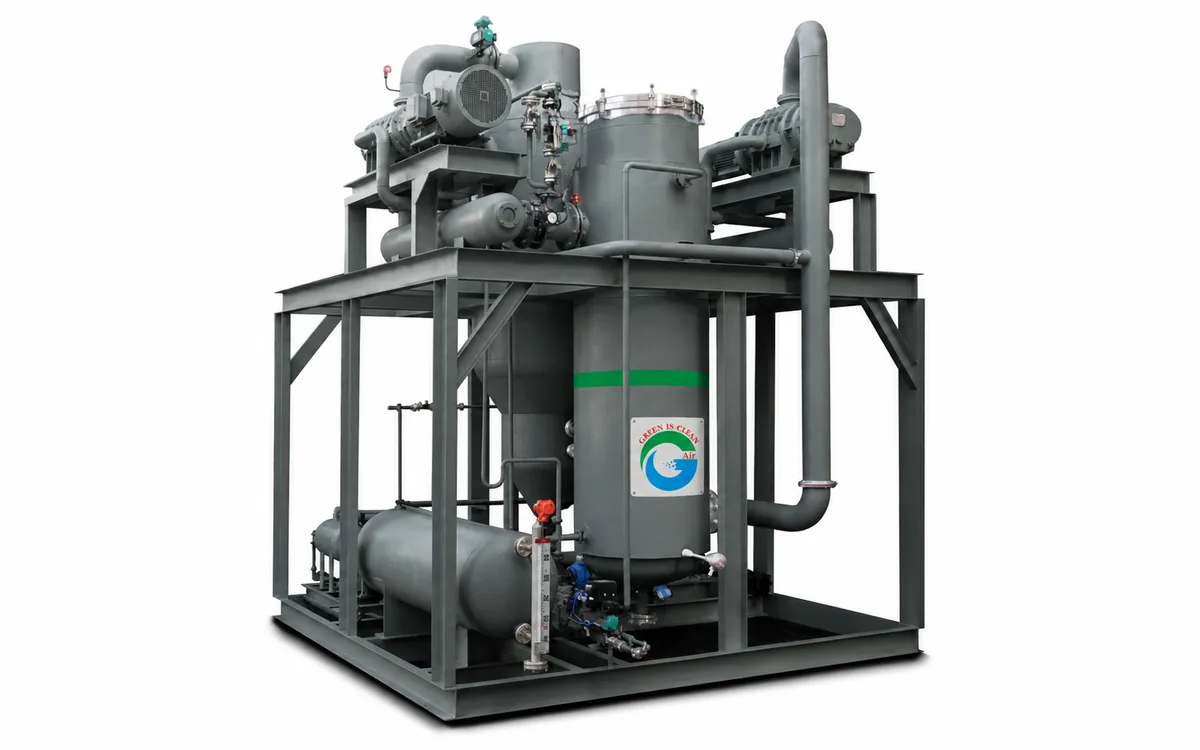
Overview
In a conventional evaporator, vapour is boiled off using fresh steam and then condensed and thrown away, taking its latent heat with it. Mechanical vapour recompression takes that vapour, compresses it slightly to raise its condensing temperature, and feeds it back as the heating medium.
The effect on energy consumption is dramatic. A well-designed MVR evaporator typically uses 90 to 95% less primary energy than a single-effect steam evaporator, because after start-up almost no fresh steam is required at all.
Key benefits
Up to 95% less energy
The latent heat is recycled rather than dumped into a cooling tower.
Little or no live steam
After start-up, most MVR plants need only the compressor's electrical input.
Smaller cooling load
No large condenser duty, which removes cooling tower capacity and water consumption.
Engineered to your process
Selected from your evaporation rate, boiling point elevation and product properties.
How it works
Vapour coming off an evaporator is compressed, which raises its temperature, and that hotter vapour is then used to heat the same evaporator. The heat goes round instead of being made again.
What that replaces is steam. An evaporator on mechanical vapour recompression can use a fraction of the energy of one fed by a boiler, because the heat is being moved rather than generated.
The compressor is the whole machine. It is specified for the vapour rather than for air, which changes the materials, the sealing and the control arrangement.
- Vapour compressed and reused as the heat source
- Replaces most or all of the steam demand
- Energy moved rather than generated
- Compressor specified for the vapour
- Fan or screw type by duty
- Materials selected for the process liquor
- Integrated with the evaporator controls
- Performance guaranteed and tested
Is it worth it on your plant
It suits a continuous evaporation duty with a steady load and a lot of annual hours. It does not suit a batch process that runs three months a year.
We size it against your evaporation rate, your boiling point rise and the hours you actually run, and we show the figures against what you spend on steam today.
If the payback is poor we will say so. An honest no on this is worth more than a hopeful yes, because the capital involved is significant.
- Suits continuous duty with high annual hours
- Sized on evaporation rate and boiling point rise
- Compared against your current steam cost
- Payback shown before you commit
- Honest answer when it does not pay
- Integration with existing plant designed
- Metered so the saving is measured
- Commissioned by our own team
Parts and service
Seals, bearings and the wetted parts, with intervals set by the liquor rather than by a general rule.
Fouling on the vapour side is the quiet failure. Performance falls, the steam valve opens to make up the difference, and the saving disappears without any alarm.
We record compression ratio, power and steam make up at every visit so the system is proved to still be paying for itself.
- Seal and bearing kits by interval
- Intervals set by the process liquor
- Vapour side fouling checked at every visit
- Steam make up recorded as the real measure
- Compression ratio and power logged
- Overhauls planned around your shutdown
- Site spares agreed at commissioning
- Fixed price under a service plan
Frequently asked questions
What is mechanical vapour recompression?
Taking the vapour a process gives off, compressing it slightly, and using its own recovered heat to drive the evaporation instead of fresh steam.
Why does it save so much?
Because compressing vapour costs far less energy than raising steam. Typical systems return five to twenty times the energy they consume.
Where is it used?
Evaporation and concentration, dairy, sugar, chemicals, desalination and effluent treatment. Anywhere a lot of water is being boiled off continuously.
What machine does the compression?
A high-flow, low-ratio machine (a turbo fan, a centrifugal or a screw compressor), chosen for the vapour flow and the temperature lift needed.
How much lift can it give?
Usually a few degrees of temperature rise, which is all the process needs. Large lifts are inefficient and normally point to a different design.
Does it replace the boiler?
It replaces most of the running steam demand. A boiler is still typically needed for start-up and top-up duty.
What is the payback?
On a continuous evaporation plant, often two to four years. Running hours are what decide it: an intermittent process rarely justifies the capital.
What is the main risk?
Fouling and carry-over on the compressor. Vapour quality, droplet separation and material selection are where these projects succeed or fail.
Can it be retrofitted?
Sometimes, on an existing evaporator, but it must be studied properly. The evaporator's temperature difference decides whether it will work at all.
How do we assess it?
With a mass and energy balance on the existing plant. We would rather tell you it does not suit than sell a system that underperforms.
Related products
Not sure which model you need?
Send us your air demand, working pressure and running hours. Our engineers will size the machine and send a written recommendation, no cost, no obligation.