
Process gas screw compressors
Screw compressors engineered for gases other than air.
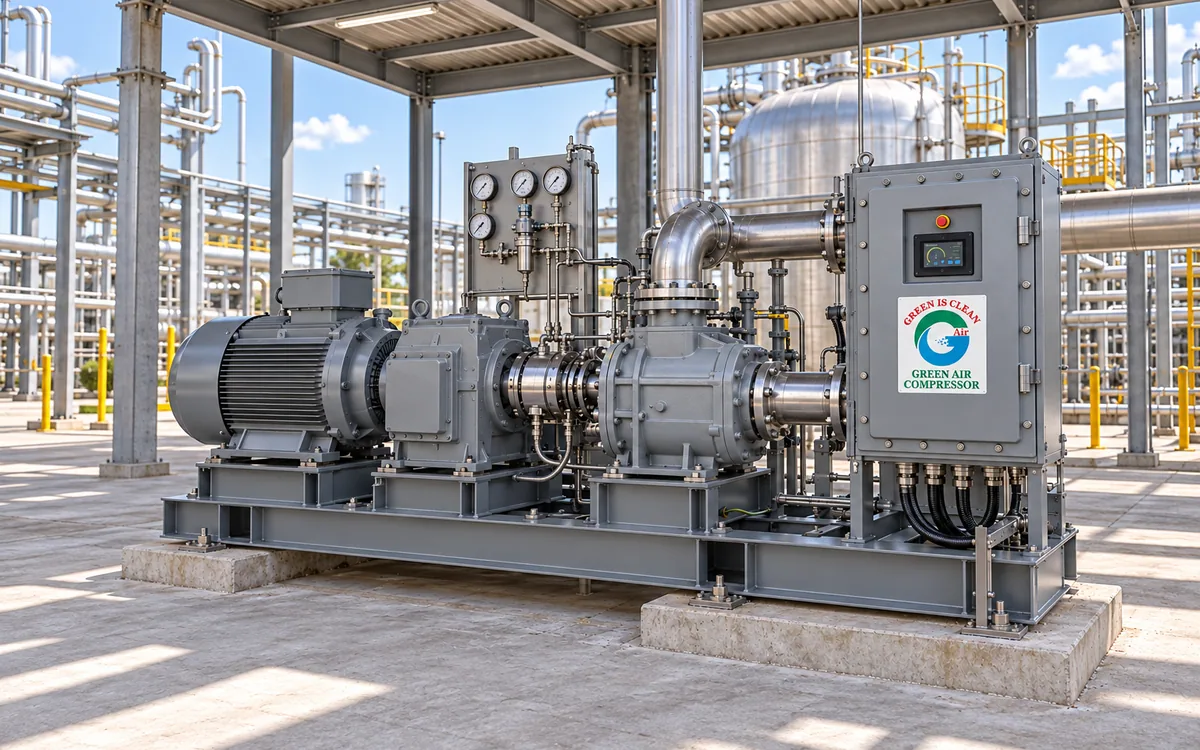
Overview
Compressing nitrogen, biogas, hydrogen-rich streams or refrigerants is a different engineering problem from compressing air. Sealing, materials, safety classification and control all change with the gas.
We supply oil-injected and oil-free screw packages engineered around a specific gas composition, with the sealing arrangement, materials and instrumentation chosen for that duty and documented accordingly.
Key benefits
Gas-specific engineering
Materials, seals and clearances selected for your gas composition rather than adapted from an air machine.
Sealing to suit the risk
Double mechanical seals with buffer gas where leakage cannot be tolerated.
Hazardous area versions
ATEX and IECEx classified packages available.
Complete package
Skid, cooler, separator, instrumentation and control supplied and tested as one unit.
How it is built
The same screw principle as an air compressor, built for a specific gas rather than for air. That changes the materials, the seals, the lubricant and often the whole containment arrangement.
Oil injected designs suit gases that tolerate oil and where it can be recovered. Oil free designs are used where the gas must stay uncontaminated or where it would degrade the oil.
Sealing is the engineering problem on process gas. Where leakage cannot be tolerated the shaft seal arrangement is specified with the same care as the compression itself.
- Built for a named gas, not for air
- Oil injected or oil free by duty
- Materials selected for the gas
- Shaft sealing specified to the leakage requirement
- Slide valve or variable speed capacity control
- Skid mounted with full instrumentation
- Certification for the application
- Performance tested before despatch
What the controller does
Capacity follows the process. A slide valve is common on refrigeration duty and variable speed is usually more efficient across a wide range, and we will say which suits your case.
Gas temperature, pressure and seal condition are all monitored, because on process gas a seal problem is a safety matter rather than a maintenance one.
Interlocks with the plant system are designed in rather than added. The compressor has to behave correctly when the process upstream or downstream misbehaves.
- Slide valve or variable speed capacity control
- Gas temperature and pressure monitored
- Seal condition monitored and alarmed
- Interlocks with the plant designed in
- Full trending and fault history
- Volt free contacts throughout
- Remote monitoring as standard
- Emergency shutdown arrangement
Parts and service
Seals, bearings and the lubricant where there is one, all on intervals set by the gas rather than by a general rule.
Parts for process gas duty are not interchangeable with air machine parts even where the numbers look similar. We quote against the serial number and the gas together.
Work on these machines is done by engineers trained on the gas as well as on the compressor, and the records are kept accordingly.
- Intervals set by the gas, not a general rule
- Seals and materials specific to the duty
- Quoted against serial number and gas
- Engineers trained on the application
- Records kept for regulated processes
- Site spares agreed at commissioning
- Overhauls planned around your shutdown
- Fixed price under a service plan
Frequently asked questions
How is a process screw compressor different?
It is built for a specified gas rather than air, different materials, seals and often a closed casing so nothing leaks to atmosphere.
Which gases can it handle?
Nitrogen, hydrogen, natural gas, refrigerants, biogas and many others. Composition, moisture and any corrosive component all change the specification.
Oil-injected or oil-free?
Oil-injected where the gas tolerates it and the oil can be recovered. Oil-free where the gas must stay uncontaminated or would degrade the oil.
How is leakage prevented?
By the shaft seal arrangement: mechanical, dry gas or double seals with a buffer. The choice depends on the gas and the consequence of a leak.
Can it handle wet or dirty gas?
Better than most machine types, within limits. Screw compressors tolerate some liquid carry-over that would damage a reciprocating machine.
What about explosive atmospheres?
ATEX-compliant configurations are available. We specify to the zone and provide the documentation your safety case requires.
How is capacity controlled?
Slide valve or variable speed. Slide valve is common on refrigeration duty. Variable speed is usually more efficient across a wide range.
What monitoring is needed?
Gas temperature, seal condition, vibration and oil quality as a minimum. Process gas machines justify condition monitoring far more readily than air machines.
Who does the maintenance?
Trained technicians only, with gas-handling procedures. This is not the machine to hand to a general fitter with a service kit.
What do you need to quote?
Gas composition, flow, inlet and outlet pressure, temperature, and the area classification. From those six we can specify properly.
Related products
Not sure which model you need?
Send us your air demand, working pressure and running hours. Our engineers will size the machine and send a written recommendation, no cost, no obligation.